
Google scraping requires specialized proxies that can handle sophisticated anti-bot detection systems while maintaining high success rates for SERP data extraction. Whether you’re tracking keyword rankings, monitoring competitor positions, or collecting local search data, choosing the right residential proxies for Google SERP makes the difference between successful data collection and constant blocks. This guide covers the top proxy providers designed specifically for Google SERP scraping in 2026. Discover the Best Google Scraping Proxies in 2026
Start accessing authentic Indian market data today with ResiProx’s premium Indian residential proxies featuring 3.1M+ IPs and city-level targeting.
- Why Google Scraping Requires Specialized Proxies
- Essential Features for Google Scraping Proxies
- Top 10 Best Google Scraping Proxies in 2026
- Residential vs ISP vs Datacenter Proxies for Google
- How to Avoid Google CAPTCHAs When Scraping
- Best Rotation Strategies for Different Google Services
- Common Google Scraping Mistakes and How to Fix Them
- Legal and Ethical Considerations for Google Data Collection
- FAQ
Why Google Scraping Requires Specialized Proxies
Google operates one of the most advanced anti-bot detection systems on the internet, making standard proxies insufficient for reliable SERP scraping. The search giant analyzes multiple signals to identify automated traffic, including request patterns, IP reputation, browser fingerprints, and behavioral characteristics.
Google’s Anti-Bot Detection Systems
Google’s defense mechanisms work on multiple layers simultaneously. The platform monitors request rates from individual IP addresses, triggering CAPTCHAs or temporary blocks when activity exceeds normal user thresholds. Rate limiting happens faster than most websites, often flagging patterns after just a few dozen queries from the same IP within minutes.
Browser fingerprinting presents another major challenge. Google analyzes user agents, JavaScript execution patterns, mouse movements, and dozens of other browser characteristics to distinguish real users from automated scripts. Missing or inconsistent signals immediately raise red flags, leading to verification challenges or outright blocks.
Machine learning models continuously analyze behavioral patterns across sessions. These systems detect unnatural navigation sequences, suspiciously fast page interactions, and repetitive query patterns that human users wouldn’t exhibit. The detection algorithms improve constantly, adapting to new scraping techniques as they emerge.
Why Standard Proxies Fail on Google
Datacenter proxies typically achieve only 20-40% success rates when scraping Google and similar protected platforms. Google maintains extensive databases of IP ranges associated with server farms and cloud providers, automatically flagging requests from these sources as potentially automated.
The IP reputation factor plays a huge role. Google tracks the history of each IP address, noting how many queries originate from it, whether it triggers CAPTCHAs frequently, and if multiple accounts access it. Clean IP reputation becomes essential for maintaining access to search results without constant interruptions.
Standard proxy rotation patterns often create detectable signatures. Switching IPs too quickly, using sequential IP ranges, or maintaining identical browser fingerprints across different IPs all signal automated activity to Google’s detection systems.
What Makes Proxies Google-Compatible
Residential proxies achieve 85-95% success rates on protected platforms because they use genuine IP addresses assigned by internet service providers to real homes. Google’s systems recognize these IPs as legitimate residential connections, treating requests as normal user activity rather than automated scraping.
Rotation strategies matter enormously for Google scraping. Per-request rotation helps avoid rate limits by spreading queries across different IPs, while session-based proxies maintain consistency for multi-page scrapes like browsing through search result pages. The right approach depends on whether you’re collecting bulk SERP data or tracking specific query journeys.
Geographic authenticity adds another layer of legitimacy. Proxies that accurately represent the target location through local ISP assignments appear more natural than generic regional IPs. City-level targeting becomes particularly important for local SERP scraping, where search results vary dramatically between nearby locations.
Scraping Different Google Services
Google Search, Google Shopping, and Google Images each present unique challenges. Standard search results require careful request pacing and cookie management to avoid detection. Shopping results often trigger additional verification when scrapers attempt bulk product data extraction. Image search typically allows higher request volumes but requires proper JavaScript rendering to load all results.
Legal and Ethical Considerations
Google’s Terms of Service explicitly prohibit automated queries without permission. While web scraping occupies a legal gray area in many jurisdictions, violating TOS can lead to permanent IP bans and potential legal action for large-scale commercial operations. Compliance requirements include respecting robots.txt directives, implementing reasonable rate limits, and avoiding disruption to Google’s services.
Ethical scraping practices balance business needs with responsible data collection. This includes implementing throttling mechanisms, avoiding unnecessary load on Google’s infrastructure, and collecting only data necessary for legitimate purposes like market research or SEO analysis.
Essential Features for Google Scraping Proxies
Selecting the right proxy setup determines whether your Google scraping operation succeeds or fails repeatedly with blocks and CAPTCHAs. Several features separate Google-compatible proxies from basic solutions that struggle against modern detection systems.
Residential vs Datacenter vs ISP Proxies
Residential proxies deliver the highest success rates for Google scraping because they originate from real household internet connections. These IPs come from actual ISP customers, making requests appear identical to regular users browsing search results. Success rates typically reach 85-95% on Google with properly configured residential proxies.
Datacenter proxies offer faster speeds (100-1000 Mbps) and lower costs but achieve only 20-40% success rates on Google. Google easily identifies these IPs as coming from server farms rather than residential locations, leading to frequent CAPTCHAs and blocks. They work best for less protected scraping targets, not search engines.
ISP proxies bridge the gap, offering datacenter speeds with residential authenticity. These IPs are registered to internet service providers but hosted in data centers, providing faster response times than pure residential proxies while maintaining better success rates than standard datacenter IPs.
Rotation Strategies for Google
Per-request rotation switches the IP address for every query, maximizing the number of requests possible before triggering rate limits. This approach works well for bulk SERP scraping where you’re collecting data across many keywords without needing to maintain session continuity.
Session-based rotation maintains the same IP for multiple related requests before switching. This strategy suits scenarios where you need to browse through multiple pages of search results for a single query, maintaining cookies and session data that Google expects from real users.
Timing between rotations affects detection risk significantly. Rotating proxies that switch too quickly or in predictable patterns create suspicious traffic signatures. Random rotation intervals that mimic natural user behavior help avoid triggering Google’s machine learning detection models.
Success Rate Expectations
Target success rates above 95% for sustainable Google scraping operations. Lower success rates mean constant retries, higher costs, and unreliable data collection. Premium residential proxy providers typically guarantee 99%+ success rates specifically for search engine scraping.
Failed requests cost money and time. Each retry consumes bandwidth, increases your total request volume, and slows data collection pipelines. High success rates reduce operational overhead and deliver more predictable scraping performance.
Geographic Targeting Capabilities
Country-level targeting forms the baseline for international SERP monitoring, but city-level targeting becomes essential for local search scraping. Search results vary dramatically between cities, even within the same state or region. Accurate local SERP data requires geo-targeted proxies that genuinely originate from the target city’s ISPs.
ISP-level targeting adds another precision layer. Different internet providers within the same city sometimes see slightly different search results due to Google’s personalization algorithms. Advanced proxy providers offer ISP selection for maximum accuracy in SERP data collection.
Speed and Response Times
Response times under 0.6 seconds keep scraping operations efficient without sacrificing success rates. Residential proxies naturally operate slower than datacenter proxies, but well-optimized networks minimize this gap. Balance speed requirements against the need for IP authenticity when choosing proxy types.
Connection stability matters as much as raw speed. Proxies that maintain consistent performance during high-volume scraping prevent pipeline disruptions and failed batch jobs. Look for providers guaranteeing 99.9%+ uptime specifically for search engine scraping workloads.
Concurrent Request Handling
Unlimited concurrent sessions enable parallel SERP scraping across multiple keywords, locations, and search parameters simultaneously. Google’s rate limits apply per IP address, so rotating through large IP pools while maintaining multiple concurrent connections maximizes data collection throughput.
Bandwidth allocation affects concurrent scraping capacity. Providers offering unlimited bandwidth eliminate concerns about data caps during large-scale SERP extraction campaigns. This becomes particularly important for tracking hundreds or thousands of keywords across multiple locations.
CAPTCHA Avoidance Mechanisms
Clean IP pools with strong reputation scores minimize CAPTCHA triggers. Providers that actively monitor and remove flagged IPs from their networks maintain higher success rates. Ethically sourced residential IPs from legitimate users naturally carry better reputation than recycled or compromised addresses.
Request pattern randomization helps avoid detection algorithms that identify automated scraping behavior. This includes varying request timing, mixing query parameters, and simulating realistic user agent rotation across different browser versions and operating systems.
Integration with Scraping Tools
API support and protocol compatibility (HTTP/HTTPS/SOCKS5) allow seamless integration with popular scraping frameworks. Providers offering documentation and code examples for tools like Scrapy, Selenium, Puppeteer, and commercial SERP APIs reduce setup time and technical complexity.
Authentication methods matter for automated workflows. Username/password authentication, IP whitelisting, and API key management each offer different security and convenience tradeoffs depending on your infrastructure requirements.
Top 10 Best Google Scraping Proxies in 2026
1. 🏆ResiProx – Best Google Scraping Proxies in 2026 🏆
Resiprox Premium Proxies – Unlock the Web with Power and Precision
Introducing Resiprox, the ultimate proxy solution designed to supercharge your online operations. With our Residential Proxies and Mobile Proxies, you get unmatched access to web data at scale, robust security, and seamless connectivity all backed by a free trial to experience the difference firsthand.
Product Features
- Rotating Residential Proxies: Harness the power of 10M+ ethically-sourced IPs across 180+ countries. These proxies rotate dynamically to bypass IP blocks, CAPTCHAs and delivering 99.9% uptime and precise targeting at the country, city, or ZIP code level.
- Rotating Mobile Proxies: Powered by 4G/LTE/5G networks, our mobile proxies offer lightning-fast speeds with <0.3s response times and a 99.9% success rate perfect for real-time applications.
- Global IP Network: Tap into millions of IPs, including 3.5M+ in the US, 1.8M+ in Brazil, 3.1M+ in India, and more, ensuring coverage wherever you need it.
- Advanced Capabilities: Enjoy HTTPS & SOCKS5 support, unlimited concurrent sessions, and flexible rotating or sticky sessions, all wrapped in premium IP quality.
Product Specifications:
- Performance: High-speed browsing with 99.9% uptime and 24/7 expert support.
- Integration: Seamlessly works with Node.js, Python, PHP, Selenium, and more, featuring a dynamic endpoint generator and robust API access.
What It’s Built For:
Resiprox proxies are your all-in-one tool for:
- Web Scraping: Extract public data effortlessly for insights and growth.
- Price Monitoring: Track prices across regions in real-time.
- Multi-Accounting: Manage multiple accounts without limits.
- SEO & Ad Verification: Monitor rankings and verify ads globally.
- Cybersecurity: Protect your brand and test applications securely.
- Specialized Tasks: From sneaker botting to travel fare aggregation, Resiprox delivers.
Why Resiprox Stands Out:
This isn’t just a proxy, it’s a game-changer. With comprehensive documentation, multi-platform compatibility, and a team of experts available 24/7, Resiprox ensures your projects run smoothly. Whether you’re a business scaling operations, a researcher gathering data, or a developer testing apps, our proxies adapt to your needs with precision and reliability.
Resiprox Premium Proxies – Your Key to a Smarter, Faster, and More Connected Online World.
Click here to discover our :
2. ProxyEmpire
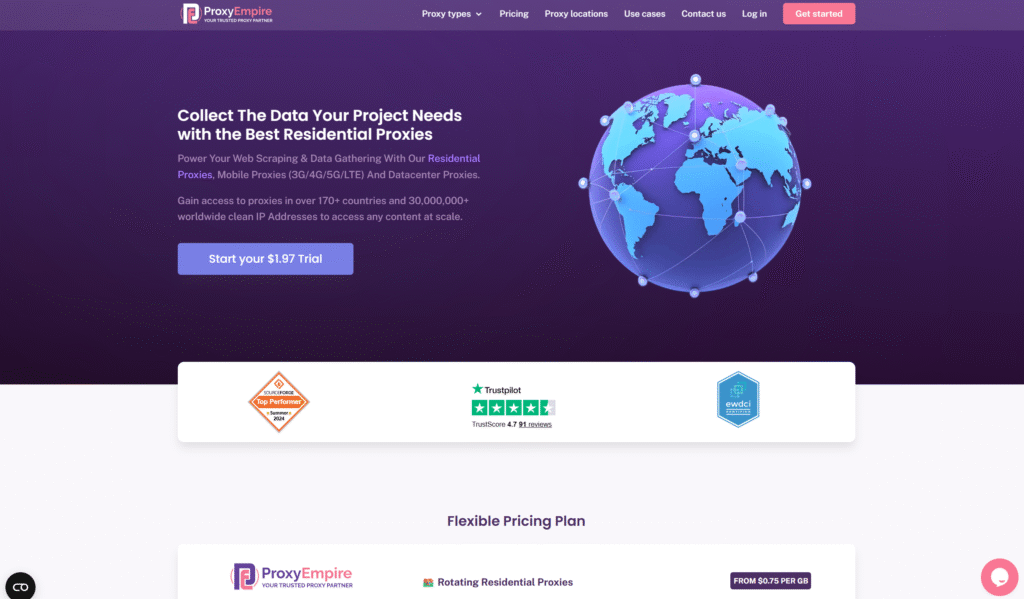
ProxyEmpire offers premium residential proxies with 30 million clean IPs across 170+ countries, emphasizing ethical sourcing and IP quality over pool size. The network achieves 0.6-second response times with both rotating and static proxy options for different scraping strategies.
Ethical sourcing practices ensure IPs come from legitimate users who consent to network participation, resulting in cleaner reputation scores and fewer blocks on Google. This quality-focused approach delivers higher success rates than services relying on questionable IP acquisition methods.
The platform particularly suits businesses prioritizing data collection reliability and ethical practices for SEO monitoring and competitive analysis. Static residential proxy options enable long-term SERP tracking from consistent IP addresses when required.
Key Features:
- 30M ethically sourced residential IPs
- 0.6-second average response time
- Rotating and static proxy options
- 170+ country coverage
- Clean IP reputation focus
Pros:
- Ethical sourcing improves success rates
- Fast response times for efficient scraping
- Static residential options for specialized needs
- Strong IP reputation reduces blocks
Cons:
- Smaller IP pool than mass-market providers
3. Oxylabs
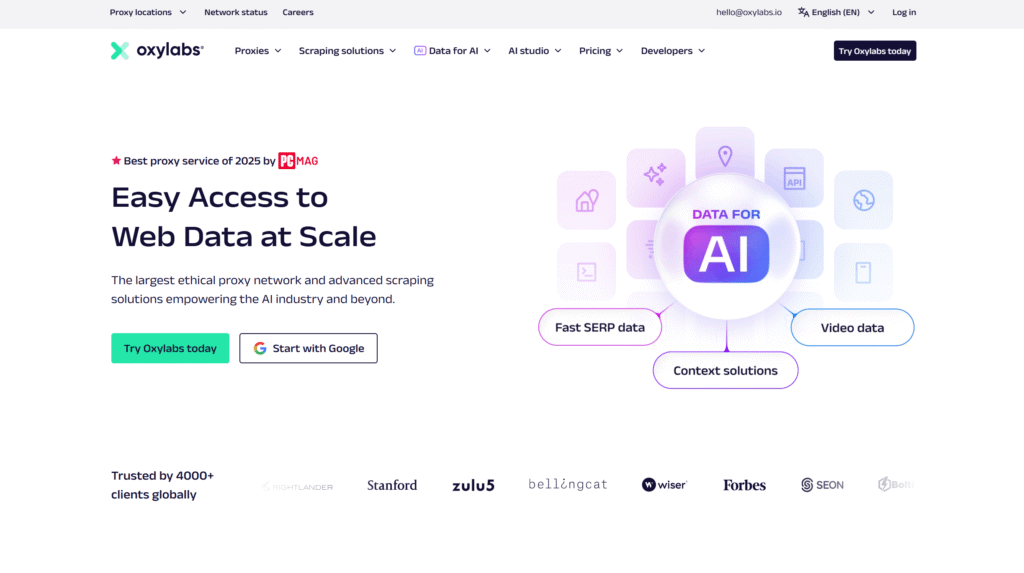
Oxylabs provides premium proxy services with 100 million+ residential IPs specifically designed for scraping major platforms like Google. The network achieves 99.9% uptime with city-level targeting capabilities that enable accurate local SERP data collection across global markets.
AI-powered rotation technology adapts to Google’s detection patterns in real-time, maintaining high success rates while minimizing CAPTCHA encounters. The platform integrates seamlessly with popular scraping tools and supports HTTP, HTTPS, and SOCKS5 protocols for flexible deployment options.
Response times remain consistently fast even during high-volume scraping operations, helping businesses maintain efficient data collection pipelines. Oxylabs offers dedicated account management and technical support for teams running mission-critical SERP monitoring campaigns.
Key Features:
- 100M+ residential IPs with global coverage
- City-level geotargeting for local search accuracy
- AI-powered rotation algorithms
- 99.9% uptime guarantee
- Full protocol support (HTTP/HTTPS/SOCKS5)
Pros:
- Premium network quality with excellent Google success rates
- Advanced AI optimization reduces manual configuration
- Strong uptime guarantees for 24/7 monitoring
- Responsive technical support for complex setups
Cons:
- Higher price point targets enterprise customers
- May offer more features than needed for basic SERP scraping
4. Decodo
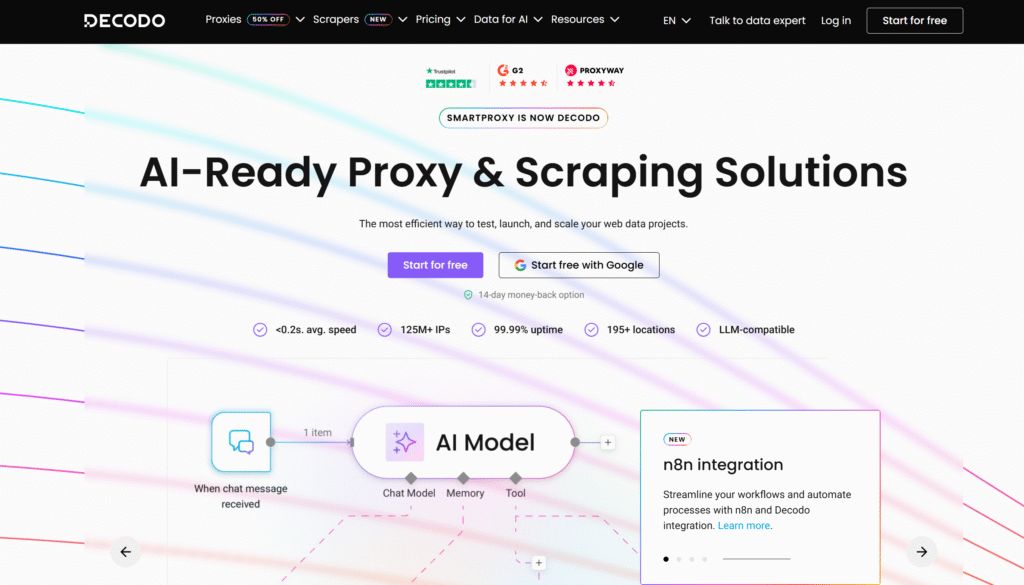
Decodo (formerly Smartproxy) combines affordability with performance through 125 million+ residential IPs across 195 locations. The service achieves response times under 0.2 seconds, making it one of the faster options for high-volume Google SERP scraping operations.
Unlimited session flexibility accommodates both rotating and sticky connection strategies depending on scraping requirements. Precise targeting options down to city level enable accurate local search data collection for businesses tracking rankings across specific geographic markets.
The platform balances cost efficiency with reliable performance, making it accessible for mid-size teams and agencies running multiple SERP monitoring projects. Setup remains straightforward with clear documentation for common Google scraping scenarios.
Key Features:
- 125M+ IPs in 195 locations worldwide
- Sub-0.2 second response times
- Unlimited session options (rotating and sticky)
- City-level geographic precision
- User-friendly dashboard and API
Pros:
- Fast response times speed up large-scale scraping
- Affordable pricing without sacrificing quality
- Simple setup process for quick deployment
- Good balance of features and cost
Cons:
- IP pool smaller than top-tier enterprise providers
- Advanced features may be limited compared to premium services
5. IPRoyal
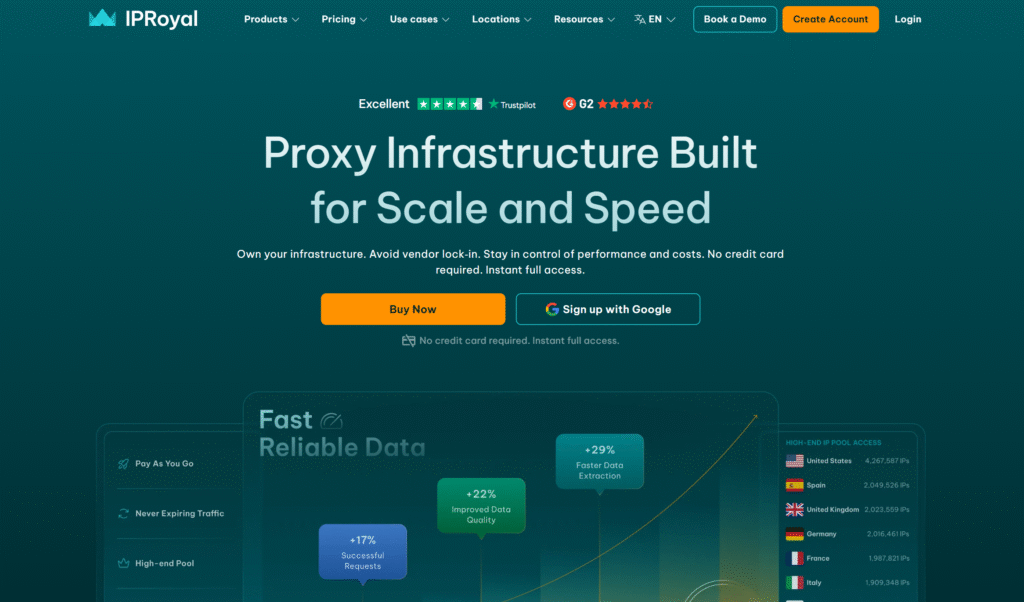
IPRoyal offers budget-friendly residential proxies with 32 million+ IPs and a unique non-expiring traffic model that benefits irregular scraping schedules. The service provides city and state-level targeting with support for HTTP, HTTPS, and SOCKS5 protocols.
Non-expiring traffic allocation means teams can purchase bandwidth in advance without worrying about monthly resets, making it ideal for project-based SERP data collection. This pricing structure particularly benefits businesses with seasonal keyword monitoring needs or periodic competitive analysis campaigns.
Security features and scalability options make IPRoyal suitable for teams that need reliable Google scraping without premium pricing. The platform maintains consistent performance across different geographic regions with reasonable success rates on search engine targets.
Key Features:
- 32M+ residential IPs globally
- Non-expiring traffic model
- City/state targeting capabilities
- HTTP/HTTPS/SOCKS5 support
- Competitive pricing structure
Pros:
- Non-expiring bandwidth suits irregular usage patterns
- Affordable entry point for budget-conscious teams
- Flexible protocol support for different tools
- Secure connections for sensitive data collection
Cons:
- Smaller IP pool may limit very large-scale operations
- Success rates slightly lower than premium providers
6. SOAX
SOAX emphasizes compliance and ethical data collection with 191 million IPs across 195 countries. The platform features AI tools that optimize rotation patterns and achieve 99.5% success rates specifically for Google SERP scraping.
Customizable session options allow teams to fine-tune connection behavior for different Google services, from standard search to Shopping and Maps results. Support for advanced protocols including UDP and QUIC enables specialized scraping scenarios that require lower latency or specific network characteristics.
The service focuses on maintaining clean IP reputation through ethical sourcing practices, resulting in fewer blocks and CAPTCHA challenges during Google data extraction. Compliance features help businesses conduct SERP monitoring while respecting platform policies and legal requirements.
Key Features:
- 191M IPs in 195 countries
- 99.5% success rate on Google
- AI-powered optimization tools
- Customizable session management
- UDP/QUIC protocol support
Pros:
- High success rates minimize retry overhead
- Strong compliance focus for ethical scraping
- Advanced protocol options for specialized needs
- AI tools reduce manual optimization work
Cons:
- Premium pricing reflects advanced features
- Some features require technical expertise to utilize fully
7. NetNut
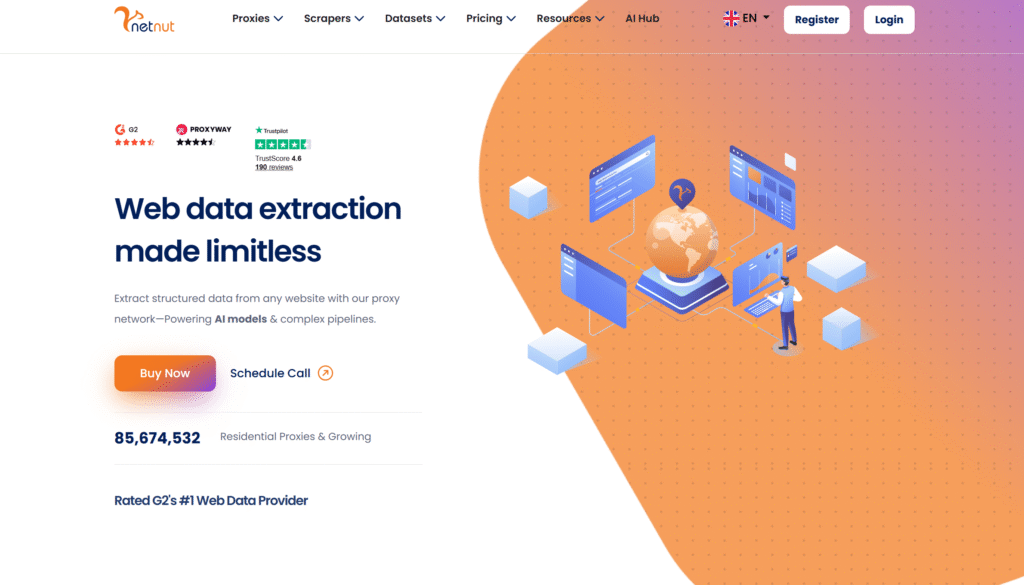
NetNut specializes in residential and ISP proxies with 85 million rotating IPs optimized for high-speed Google scraping. The platform achieves 99.99% uptime with unlimited concurrency, enabling massive parallel SERP data collection across thousands of keywords simultaneously.
ISP proxies combine datacenter speed with residential authenticity, delivering faster response times than pure residential networks while maintaining strong success rates on Google. City-level targeting provides the geographic precision needed for accurate local search monitoring.
The service excels at high-volume scraping scenarios where speed and reliability matter most. Businesses running continuous rank tracking or competitive intelligence operations benefit from the combination of unlimited concurrent requests and industry-leading uptime guarantees.
Key Features:
- 85M rotating residential and ISP IPs
- 99.99% uptime guarantee
- Unlimited concurrent connections
- City-level geographic targeting
- Optimized for high-speed operations
Pros:
- Exceptional uptime for 24/7 monitoring
- Unlimited concurrency handles massive scale
- ISP proxies offer speed advantages
- Reliable performance for mission-critical scraping
Cons:
- Premium pricing tier
- ISP proxy pool smaller than pure residential options
8. Webshare
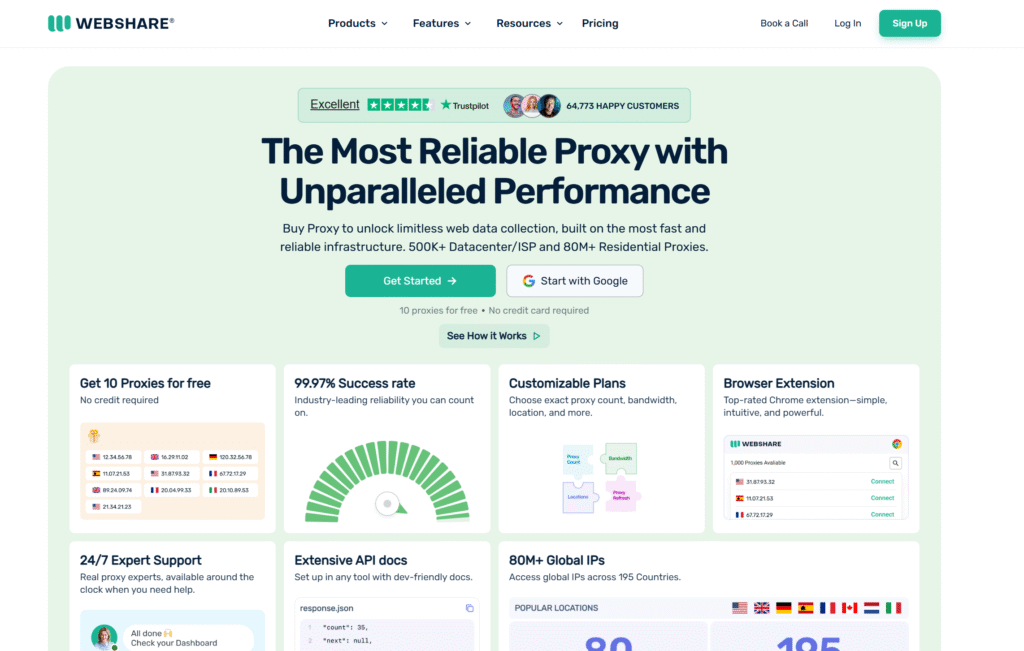
Webshare provides cost-effective proxies with 80 million+ IPs across 195 countries, featuring browser extension support that simplifies setup for less technical users. The platform handles high request volumes while maintaining reasonable success rates for Google SERP scraping.
Browser extension integration allows quick proxy configuration without complex setup procedures, making it accessible for beginners and small teams. The service supports medium-scale Google scraping projects at price points that accommodate smaller budgets.
Straightforward pricing and simple management tools reduce operational complexity for teams focused on results rather than technical infrastructure. The platform balances affordability with sufficient features for effective SERP monitoring.
Key Features:
- 80M+ IPs in 195 countries
- Browser extension for easy setup
- High request volume capacity
- Simple management interface
- Competitive pricing
Pros:
- User-friendly setup for non-technical users
- Affordable pricing for small to medium teams
- Browser extension simplifies configuration
- Good value for straightforward scraping needs
Cons:
- Success rates lower than premium providers
- Limited advanced features for complex scenarios
9. Bright Data
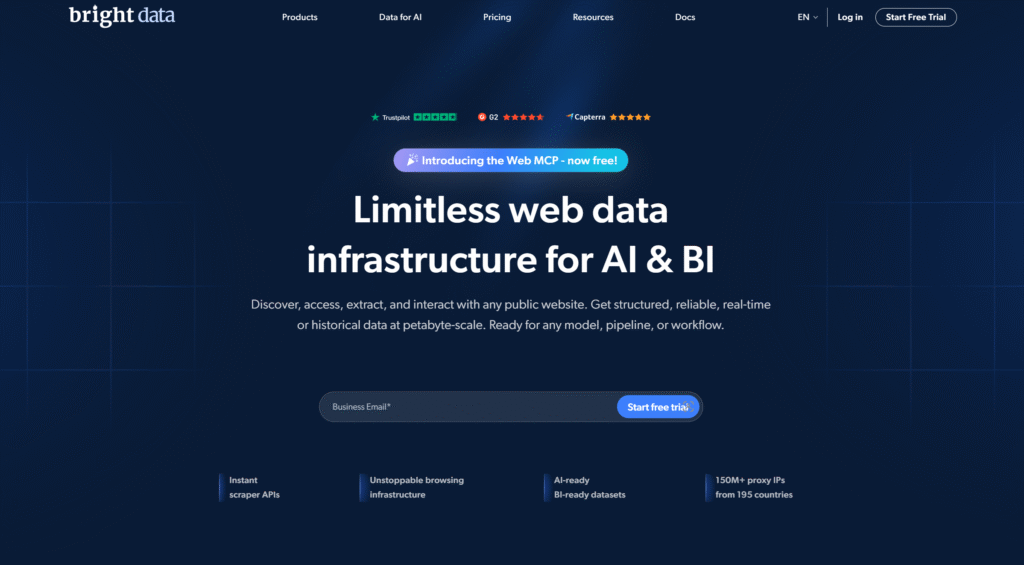
Bright Data operates one of the largest proxy networks with over 72 million residential IPs spanning 195 countries, making it a leading choice for enterprise-level Google scraping operations. The platform delivers high success rates on search engines through advanced geotargeting capabilities that reach city and even ISP-level precision for local SERP data collection.
The service features sophisticated IP rotation algorithms designed specifically for Google’s detection systems, automatically adjusting patterns to maintain access without triggering blocks. Compliance features help businesses conduct ethical data collection while respecting Google’s terms of service and legal requirements across different jurisdictions.
Integration with popular scraping tools and frameworks simplifies deployment for development teams working on SERP monitoring projects. The network supports HTTP, HTTPS, and SOCKS5 protocols with extensive documentation for common use cases like rank tracking, competitor SERP analysis, and keyword research at scale.
Key Features:
- 72M+ residential IPs across 195 countries for global SERP coverage
- City and ISP-level targeting for precise local search data
- AI-powered rotation optimized for Google’s anti-bot systems
- 99.9%+ uptime for continuous rank monitoring
- Compliance tools for ethical scraping operations
Pros:
- Massive IP pool handles enterprise-scale SERP scraping
- Advanced targeting delivers accurate local search results
- Strong track record with major search engine monitoring platforms
- Extensive API documentation and integration support
Cons:
- Premium pricing may exceed budgets for smaller operations
- Feature complexity requires technical knowledge to optimize
Residential vs ISP vs Datacenter Proxies for Google
Choosing the right proxy type significantly impacts Google scraping success rates, costs, and performance. Each proxy category offers distinct advantages and limitations for SERP data collection.
Residential proxies provide the highest success rates (85-95%) on Google because they originate from real ISP customers. Google’s systems cannot distinguish these requests from legitimate users, making residential proxies the gold standard for reliable SERP scraping. The tradeoff comes in slightly slower speeds (typically 1-10 Mbps) and higher costs compared to alternatives.
ISP proxies occupy the middle ground, combining datacenter infrastructure with residential IP registration. These proxies deliver faster speeds than pure residential options while maintaining better Google compatibility than standard datacenter IPs. Success rates typically reach 70-85%, making them effective for many SERP monitoring scenarios where speed matters.
Datacenter proxies offer the fastest performance (100-1000 Mbps) at the lowest cost but achieve only 20-40% success rates on Google. Google easily identifies and often blocks datacenter IP ranges, leading to frequent CAPTCHAs and failed requests. These proxies work better for less protected scraping targets rather than search engines with sophisticated detection.
Mobile proxies provide another option, using cellular network IPs that appear as smartphone users to Google. These achieve excellent success rates but come at premium pricing and typically offer lower speeds than residential proxies.
For serious Google scraping operations, residential proxies deliver the best balance of success rate and reliability despite higher costs. Teams can optimize expenses by using residential proxies for Google scraping while reserving cheaper datacenter proxies for less protected data sources.
How to Avoid Google CAPTCHAs When Scraping
CAPTCHA challenges represent one of the biggest obstacles in Google scraping, but several strategies minimize their frequency and impact on data collection operations.
Clean IP reputation forms the foundation of CAPTCHA avoidance. Google assigns reputation scores to IP addresses based on historical behavior, query patterns, and abuse indicators. Using proxies from providers that actively monitor and rotate out flagged IPs maintains cleaner reputation scores that trigger fewer verification challenges.
Request pacing prevents rate limit triggers that cause CAPTCHA responses. Limiting queries to 10-15 per minute from each IP mimics natural user behavior better than rapid-fire requests. Randomizing intervals between requests (2-8 seconds) creates more natural patterns than fixed timing that signals automation.
User agent rotation across realistic browser versions helps avoid fingerprinting detection. Google analyzes browser characteristics to identify bots, so maintaining consistent user agent/IP combinations while rotating between different realistic configurations reduces detection risk.
Cookie management maintains session legitimacy across multiple requests. Accepting and properly storing cookies from Google, including consent and tracking cookies, makes scraping sessions appear more like real users browsing search results over time.
JavaScript rendering enables execution of Google’s client-side detection scripts. Headless browsers like Puppeteer or Selenium that properly render JavaScript create more authentic sessions than simple HTTP requests, though at the cost of increased resource consumption.
Residential proxy quality matters enormously for CAPTCHA avoidance. Premium providers with ethically sourced IPs from legitimate users maintain better reputation than services using compromised or recycled addresses. The investment in quality proxies pays dividends through dramatically reduced CAPTCHA rates.
If CAPTCHAs do appear, automated solving services like 2Captcha or Anti-Captcha can handle verification automatically. However, relying primarily on prevention through proper proxy configuration and request patterns proves more cost-effective than solving large volumes of challenges.
Best Rotation Strategies for Different Google Services
Different Google services require distinct rotation approaches to maximize success rates and avoid detection. Tailoring strategies to specific platforms improves data collection efficiency.
Google Search Standard Results
Per-request rotation works best for bulk keyword scraping across many search queries. Switching IPs for each query distributes requests across Google’s infrastructure, preventing any single IP from exceeding rate limits. This approach enables monitoring thousands of keywords efficiently.
Session-based rotation suits multi-page result collection for single queries. Maintaining the same IP while clicking through result pages (1-10) appears more natural to Google’s behavioral analysis. Rotate to a fresh IP after completing each keyword’s full result set.
Google Shopping
Sticky sessions prove essential for Google Shopping scraping because product listings often require multiple requests to load images, prices, and seller information. Maintaining the same IP for 2-5 minutes while collecting complete product data prevents session breaks that trigger detection.
Geographic targeting accuracy matters more for Shopping than standard search. Product availability and pricing vary significantly by location, so city-level targeting through geo-targeted proxies ensures data accuracy for e-commerce intelligence.
Google Images
Higher request volumes are typically possible on Google Images compared to standard search. Image scraping often requires loading multiple result pages, but these requests trigger fewer anti-bot measures. Still, limiting to 20-30 images per IP before rotating maintains safe margins.
JavaScript rendering becomes critical for Images because many results load dynamically as users scroll. Headless browsers that execute JavaScript and simulate scrolling behavior extract complete result sets more reliably than simple HTTP scraping.
Google Maps
Session persistence proves crucial for Maps scraping, especially when collecting business information across multiple locations. Maintaining the same IP while browsing a specific area’s businesses appears natural, while rapidly switching IPs for nearby locations signals bot activity.
Mobile proxies work particularly well for Maps because mobile users generate most Google Maps traffic. Cellular network IPs appear authentic for location-based queries and local business searches.
Local SERP Scraping
Accuracy depends on using proxies that genuinely originate from the target city. Google serves different results even between nearby cities, so USA residential proxies at the city level become essential for reliable local SEO monitoring rather than generic state or country-level IPs.
Common Google Scraping Mistakes and How to Fix Them
Even experienced teams make errors that reduce success rates and increase costs. Avoiding common pitfalls improves scraping efficiency significantly.
Using Generic Datacenter Proxies
Many teams start with cheap datacenter proxies that achieve poor results on Google. The low cost seems attractive initially, but 20-40% success rates mean paying for 2-5 requests to successfully complete each query. Upgrading to residential proxies costs more upfront but delivers better value through 85-95% success rates and fewer retries.
Insufficient Geographic Targeting
Scraping Google without proper geographic specification often returns irrelevant results. Google’s personalization algorithms serve different content based on location, so monitoring rankings requires matching proxy location to the target market. City-level targeting prevents the “close enough” problem where nearby city results don’t reflect actual target audience searches.
Ignoring Request Pacing
Sending requests too quickly triggers rate limits and CAPTCHA challenges even with residential proxies. Natural users don’t execute 100 searches per minute, so scraping at unrealistic speeds signals automation. Implementing 2-8 second random delays between requests maintains more sustainable access.
Inconsistent Browser Fingerprints
Rotating IPs while maintaining identical user agents and browser characteristics creates detectable patterns. Google expects different IPs to show variation in browsers, screen resolutions, and other fingerprint components. Properly correlating IP changes with realistic browser variation improves authenticity.
Neglecting Cookie Management
Rejecting cookies or failing to maintain them across session requests makes scraping less authentic. Google uses cookies for tracking and personalization, so proper cookie handling that mimics real browser behavior reduces detection risk.
Over-Reliance on Single Proxy Pool
Putting all scraping through one provider creates vulnerability if that network experiences issues or gets flagged. Diversifying across 2-3 quality providers provides redundancy and lets teams shift traffic if one pool’s success rate drops.
Scraping Without Ethical Considerations
Ignoring robots.txt, exceeding reasonable request rates, or collecting more data than necessary risks IP bans and potential legal issues. Implementing respectful scraping practices with rotating residential proxies that minimize load protects long-term access.
Legal and Ethical Considerations for Google Data Collection
Google scraping exists in legal gray areas that vary by jurisdiction, making compliance knowledge critical for businesses conducting SERP monitoring.
Terms of Service Implications
Google’s Terms explicitly prohibit automated queries without permission. While enforcement varies and selective prosecution remains rare for small-scale operations, businesses face potential account termination, IP bans, or legal action for large commercial scraping. Understanding risks helps teams make informed decisions about scraping strategies.
Many legitimate business use cases exist for Google data collection, including SEO monitoring, competitive analysis, and market research. Courts in various jurisdictions have ruled that collecting publicly available data doesn’t violate computer fraud laws, though specific outcomes depend on methods used and jurisdiction.
Robots.txt Compliance
Respecting Google’s robots.txt directives represents basic ethical scraping practice. While enforcement remains technical rather than legal in many jurisdictions, intentionally circumventing robots.txt restrictions undermines arguments that scraping serves legitimate purposes. Responsible teams implement robots.txt checking in their scraping logic.
Rate Limiting and Resource Consumption
Scraping at rates that strain Google’s infrastructure moves from data collection into potential denial of service territory. Implementing reasonable rate limits (10-15 requests per minute per IP) ensures scraping doesn’t negatively impact platform availability for regular users. This ethical consideration also reduces detection risk.
Data Usage and Privacy
Collecting SERP data typically doesn’t raise privacy concerns since search results are public information. However, scraping that captures personal information from results, reviews, or Maps listings may trigger privacy regulations like GDPR or CCPA. Understanding what data gets collected and how it’s used prevents compliance issues.
Transparent Business Practices
Using scraped Google data for competitive intelligence, pricing decisions, or SEO strategy represents common legitimate use cases. Misrepresenting data sources, manipulating rankings, or using scraped information for fraud crosses ethical lines. Maintaining transparent practices about data collection methods protects business reputation.
Ethical Proxy Sourcing
Choosing proxy providers that source IPs ethically from consenting users rather than compromised devices matters for both practical and moral reasons. Ethically sourced proxies maintain better reputation with fewer blocks, while also ensuring scraping infrastructure doesn’t rely on malware-infected devices or unwitting participants.
Teams conducting Google scraping should consult legal counsel familiar with their jurisdiction and use case. Implementing technical best practices through quality residential proxy services combined with ethical scraping policies creates the most defensible and sustainable approach to SERP data collection.
FAQ
What makes residential proxies better for Google scraping in 2026?
Residential proxies achieve 85-95% success rates on Google because they originate from real household internet connections assigned by ISPs. Google’s detection systems recognize these IPs as legitimate users rather than bots, resulting in fewer blocks and CAPTCHA challenges. Datacenter proxies only reach 20-40% success rates because Google maintains databases of server farm IP ranges and automatically flags them as potentially automated traffic.
Can you scrape Google without getting blocked constantly?
Yes, with properly configured residential proxies and appropriate request pacing. Using rotating residential IPs, limiting queries to 10-15 per minute per IP, maintaining realistic browser fingerprints, and implementing proper cookie management allows sustainable Google scraping. The key is mimicking natural user behavior through request timing, session management, and authentic residential IP addresses rather than datacenter ranges Google easily identifies.
How much do quality Google scraping proxies cost in 2026?
Residential proxy pricing typically ranges from $5-15 per GB, with many providers offering unlimited bandwidth plans starting around $50-300 monthly depending on features and scale. ISP proxies cost slightly less at $3-8 per GB, while datacenter proxies run $1-3 per GB but achieve poor results on Google. The higher cost of residential proxies delivers better value through 3-5x higher success rates that reduce retry expenses and infrastructure complexity.
Ready to dominate the Indian market? Get started with ResiProx’s Indian private proxies and unlock precise geo-targeting across Mumbai, Delhi, Bangalore, and beyond.