

Speed matters when you’re scraping thousands of pages, managing multiple accounts, or monitoring market data in real-time. The fastest residential proxies deliver response times under one second while maintaining high success rates and reliable connections. Today’s top providers combine ethically-sourced IP pools with optimized routing infrastructure to handle high-volume scraping without sacrificing performance. Whether you need rotating proxies for data collection or static IPs for account management, choosing a fast proxy network determines your project’s success. Discover the Best Fastest Proxies in 2026
Ready to experience the fastest residential proxies in the industry? Start your free trial with Resiprox today
- Why Proxy Speed Matters
- Speed vs. Success Rate Trade-offs
- Top 24 Fastest Proxies in 2026
- 1. 🏆ResiProx – Best Fastest Proxies in 2026 🏆
- 2. ProxyEmpire
- 3. IPRoyal
- 4. Decodo (Smartproxy)
- 5. Oxylabs
- 6. SOAX
- 7. Bright Data
- 8. NetNut
- 9. NodeMaven
- 10. DataImpulse
- 11. MarsProxies
- 12. Storm Proxies
- 13. Proxy-Seller
- 14. Infatica
- 15. Roundproxies
- 16. Thordata
- 17. Proxying.io
- 18. MarsProxies
- 19. Scrapingdog
- 20. Webshare
- 21. Rayobyte
- 22. Geonode
- 23. Nimble
- 24. Massive
- Fast Proxies for Real-Time Competitive Intelligence
- Proxy Speed Testing Methodologies and Benchmarks
- Performance Benchmarking Methods
- How to Choose Fast Proxies
- What speed really means
- Why test by use case
- Key speed factors
- How to test claims
- Fast proxies by use case
- FAQ
- Do fast residential proxies help with SERP tracking?
- Should I use SOCKS5 for speed-sensitive proxy tools?
- Are rotating proxies always faster than sticky sessions?
- What matters more for fast scraping: latency or success rate?
- Can mobile proxies be fast enough for real-time monitoring?
- What makes a proxy fast?
- Are faster proxies more expensive?
- Can slow proxies affect scraping accuracy?
- Which proxy type offers the fastest speeds?
Why Proxy Speed Matters
Response time directly impacts productivity and costs. Slow proxies create bottlenecks that reduce scraping efficiency, increase timeout errors, and waste resources. Projects requiring real-time data collection or managing hundreds of concurrent sessions need sub-second response times to maintain accuracy.
Modern proxy networks achieve speeds between 0.4 to 1.2 seconds by implementing AI-powered routing, direct ISP connections, and geographically distributed servers. Faster response times mean completing data extraction projects hours or days quicker, which translates to competitive advantages in pricing intelligence, SEO monitoring, and market research.
Speed vs. Success Rate Trade-offs
Raw speed alone doesn’t guarantee optimal performance. The best proxy providers balance response time with connection success rates above 95%. A proxy delivering 0.3-second response times becomes useless if it fails 30% of requests due to IP blocks or detection.
ISP proxies typically offer the best compromise, delivering 100-300 Mbps speeds with 10-50ms latency while maintaining 90-98% success rates on protected websites. This makes them ideal for speed-sensitive applications like sneaker copping or e-commerce monitoring where milliseconds matter. Residential proxies sacrifice some speed for authenticity, achieving 85-95% success rates with 100-300ms latency.
Top 24 Fastest Proxies in 2026
1. 🏆ResiProx – Best Fastest Proxies in 2026 🏆
Resiprox Premium Proxies – Unlock the Web with Power and Precision
Introducing Resiprox, the ultimate proxy solution designed to supercharge your online operations. With our Residential Proxies and Mobile Proxies, you get unmatched access to web data at scale, robust security, and seamless connectivity all backed by a free trial to experience the difference firsthand.
Product Features
- Rotating Residential Proxies: Harness the power of 10M+ ethically-sourced IPs across 180+ countries. These proxies rotate dynamically to bypass IP blocks, CAPTCHAs and delivering 99.9% uptime and precise targeting at the country, city, or ZIP code level.
- Rotating Mobile Proxies: Powered by 4G/LTE/5G networks, our mobile proxies offer lightning-fast speeds with <0.3s response times and a 99.9% success rate perfect for real-time applications.
- Global IP Network: Tap into millions of IPs, including 3.5M+ in the US, 1.8M+ in Brazil, 3.1M+ in India, and more, ensuring coverage wherever you need it.
- Advanced Capabilities: Enjoy HTTPS & SOCKS5 support, unlimited concurrent sessions, and flexible rotating or sticky sessions, all wrapped in premium IP quality.
Product Specifications:
- Performance: High-speed browsing with 99.9% uptime and 24/7 expert support.
- Integration: Seamlessly works with Node.js, Python, PHP, Selenium, and more, featuring a dynamic endpoint generator and robust API access.
What It’s Built For:
Resiprox proxies are your all-in-one tool for:
- Web Scraping: Extract public data effortlessly for insights and growth.
- Price Monitoring: Track prices across regions in real-time.
- Multi-Accounting: Manage multiple accounts without limits.
- SEO & Ad Verification: Monitor rankings and verify ads globally.
- Cybersecurity: Protect your brand and test applications securely.
- Specialized Tasks: From sneaker botting to travel fare aggregation, Resiprox delivers.
Why Resiprox Stands Out:
This isn’t just a proxy, it’s a game-changer. With comprehensive documentation, multi-platform compatibility, and a team of experts available 24/7, Resiprox ensures your projects run smoothly. Whether you’re a business scaling operations, a researcher gathering data, or a developer testing apps, our proxies adapt to your needs with precision and reliability.
Resiprox Premium Proxies – Your Key to a Smarter, Faster, and More Connected Online World.
Click here to discover our :
2. ProxyEmpire
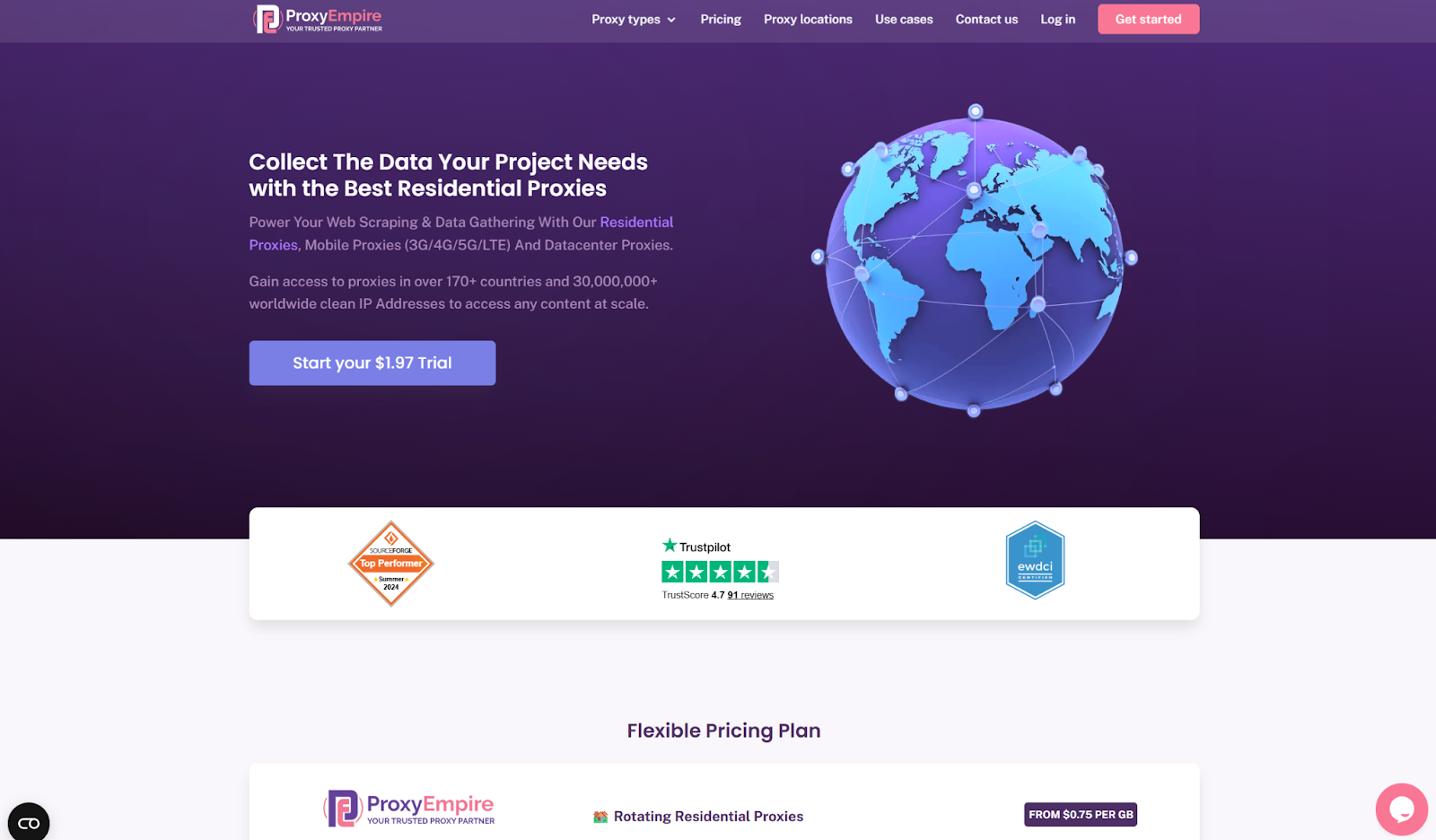
ProxyEmpire delivers blazing-fast connections through 25 million residential and mobile IPs across 174 countries, achieving 99%+ success rates with response times consistently below 1 second. The platform features adjustable rotation intervals from 30 to 900 seconds, providing flexibility for different scraping scenarios.
- Speed: Sub-second response times across most locations
- IP Pool: 25M residential and mobile IPs in 174 countries
- Protocols: HTTP, HTTPS, SOCKS5 support
- Rotation: Customizable 30-900 second intervals
- Features: Proxy manager app with real-time analytics
- Headquarters: Hong Kong
3. IPRoyal
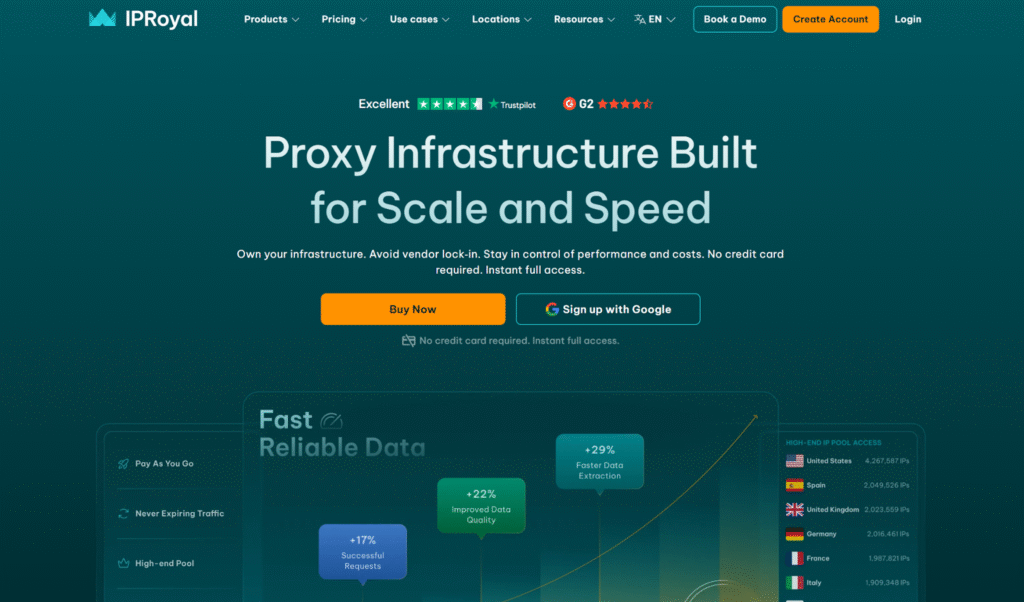
IPRoyal achieves the fastest measured response times in the industry with customizable rotation from 1 to 30 minutes across 32 million+ IPs in 195 countries. The network supports the SOCKS5 protocol for optimum speed, consistently delivering connection times under 0.8 seconds.
- Speed: Industry-leading sub-0.8s response times
- Rotation: Highly flexible 1-30 minute intervals
- IP Pool: 32M+ IPs across 195 countries
- Protocols: HTTP/HTTPS and SOCKS5
- Success Rate: 99%+ on most targets
- Pricing: Starting at $1.39 per proxy
4. Decodo (Smartproxy)
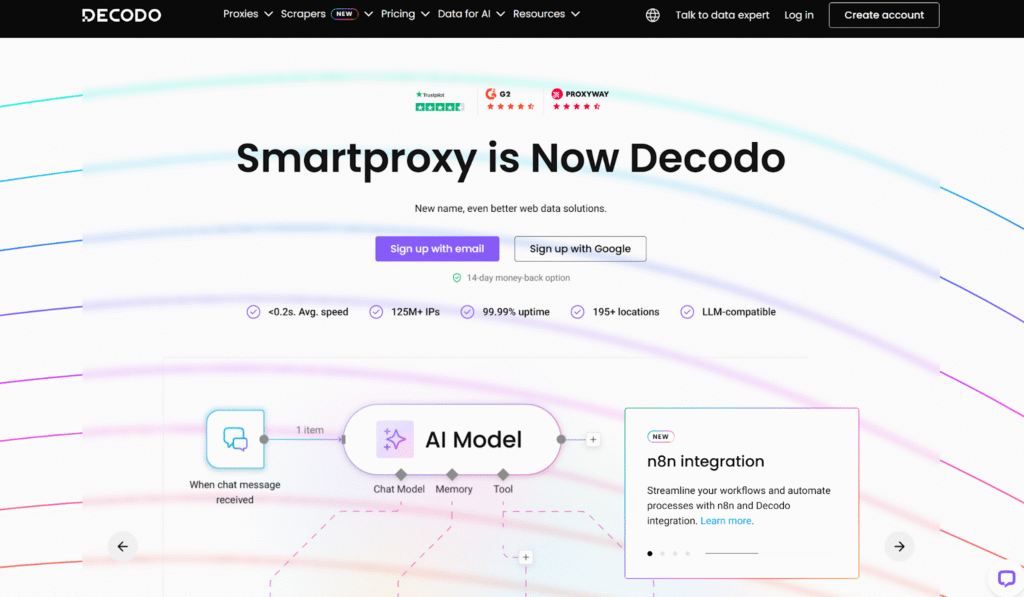
Decodo demonstrates best-in-class response times averaging sub-0.6 seconds with 99.86% success rates across 115 million+ IPs in 195+ countries. The browser extension and intuitive dashboard make it accessible for beginners while maintaining enterprise-grade performance.
- Speed: Sub-0.6s average response time
- Success Rate: 99.86% across connection attempts
- IP Pool: 115M+ IPs in 195+ countries
- Uptime: 99.99% reliability
- Features: Browser extension for easy integration
- Pricing: Starting at $4.50/GB
5. Oxylabs
Oxylabs leads the market with class-leading 0.41-second average response times and 99.82% success rates across 175 million+ IPs. The AI-powered rotation system and advanced targeting options down to ZIP code level make it the premium choice for enterprise scraping.
- Speed: 0.41s response time (fastest tested)
- Success Rate: 99.82% connection success
- IP Pool: 175M+ residential IPs
- Features: AI-powered rotation and unblocking
- Targeting: Country, city, state, ASN, ZIP code
- Pricing: Starting at $4/GB
6. SOAX
SOAX delivers very fast connections in the US with 0.55-second average response times and 99.95% success rates across 155 million+ IPs. The platform supports UDP/QUIC protocols for even faster connections on compatible platforms.
- Speed: 0.55s average response (0.90s in US)
- Success Rate: 99.95% connection attempts
- IP Pool: 155M+ IPs globally
- Protocols: HTTP/HTTPS, SOCKS5, UDP/QUIC
- Features: Flexible ASN and carrier targeting
- Pricing: Starting at $4.50/GB
- Headquarters: United States
7. Bright Data
Bright Data maintains high resilience and speed with over 99% success rates and 150 million+ IPs, backed by AI tools for automatic unblocking. The platform offers unlimited concurrent sessions and enterprise-grade compliance with SOC 2 certification.
- Speed: Sub-1s response with AI optimization
- Success Rate: >99% across most targets
- IP Pool: 150M+ IPs in 195+ countries
- Features: AI-powered CAPTCHA bypass, unlimited sessions
- Compliance: ISO 27001, SOC 2 certified
- Pricing: Starting at $2.94/GB
- Headquarters: Israel
8. NetNut
NetNut achieves high performance with 99.0% success rates and 1.0-second average response times for rotating residential proxies, leveraging ISP-level infrastructure across 85 million+ IPs. Static residential proxies deliver even faster 0.46-second response times.
- Speed: 1.0s rotating, 0.46s static residential
- Success Rate: 98-99% (rotating), 93-94% (static)
- IP Pool: 85M+ IPs via ISP partnerships
- Features: Direct ISP routing for low latency
- Protocols: HTTP/HTTPS, SOCKS5
- Pricing: Starting at $3.45/GB
9. NodeMaven
NodeMaven provides fast loading times with high stability through quality-filtered IPs and sticky sessions up to 24 hours. The platform currently offers promotional pricing with 80% extra traffic for new users.
- Speed: Sub-1s response with stability focus
- Features: Quality-filtered IP pool, 24h sticky sessions
- Success Rate: 99%+ on verified targets
- Protocols: HTTP/HTTPS, SOCKS5
- Promotion: 80% extra traffic bonus
- Headquarters: United States
10. DataImpulse
DataImpulse delivers competitive speed with 1.22-second response times and 90 million+ IPs, offering the most affordable pricing at $1/GB. Testing shows zero failed speed checks with 100% success rates across multiple platforms.
- Speed: 1.22s average response time
- Success Rate: 100% in recent speed tests
- IP Pool: 90M+ IPs with flexible targeting
- Protocols: HTTP(S) and SOCKS5
- Pricing: Cheapest at $1/GB
- Features: Works with geo-restricted platforms
11. MarsProxies
MarsProxies offers blazing-fast connections across 1 million+ IPs in 190 countries with SOCKS5 support for maximum speed. The smaller but quality-focused pool maintains consistent performance.
- Speed: Sub-second connections via optimized routing
- IP Pool: 1M+ premium IPs in 190 countries
- Protocols: HTTP/HTTPS, SOCKS5
- Features: Quality over quantity approach
- Pricing: Affordable at $3.49/GB
12. Storm Proxies
Storm Proxies specializes in fast speeds with unlimited bandwidth, making it ideal for ticket purchasing and basic scraping despite a smaller residential pool. The service focuses on simplicity and reliability.
- Speed: Fast with optimized datacenter backbone
- Bandwidth: Unlimited on all plans
- Features: Simple setup, no complex configuration
- Best For: Sneaker copping, ticket purchasing
- Cons: Limited residential IP pool
13. Proxy-Seller
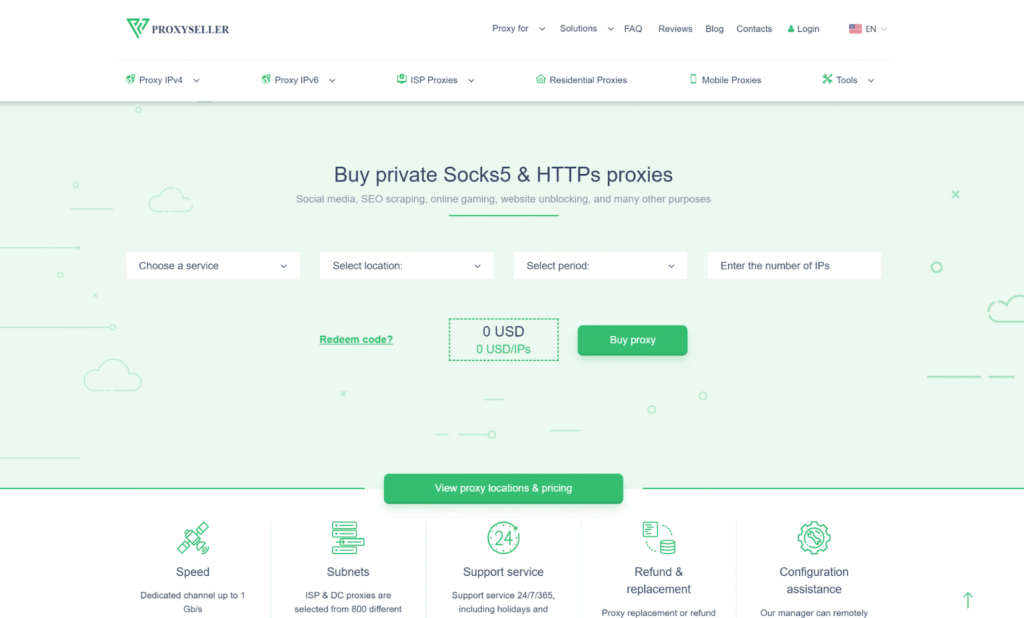
Proxy-Seller provides variable but fast speeds with SOCKS5 protocol and global coverage. The flexible IP selection makes it suitable for automation projects requiring specific targeting.
- Speed: Variable but generally fast via SOCKS5
- Protocols: HTTP/HTTPS, SOCKS5
- Features: Flexible IP selection and filtering
- Best For: Automation and bot projects
- Coverage: Global with major city targeting
14. Infatica
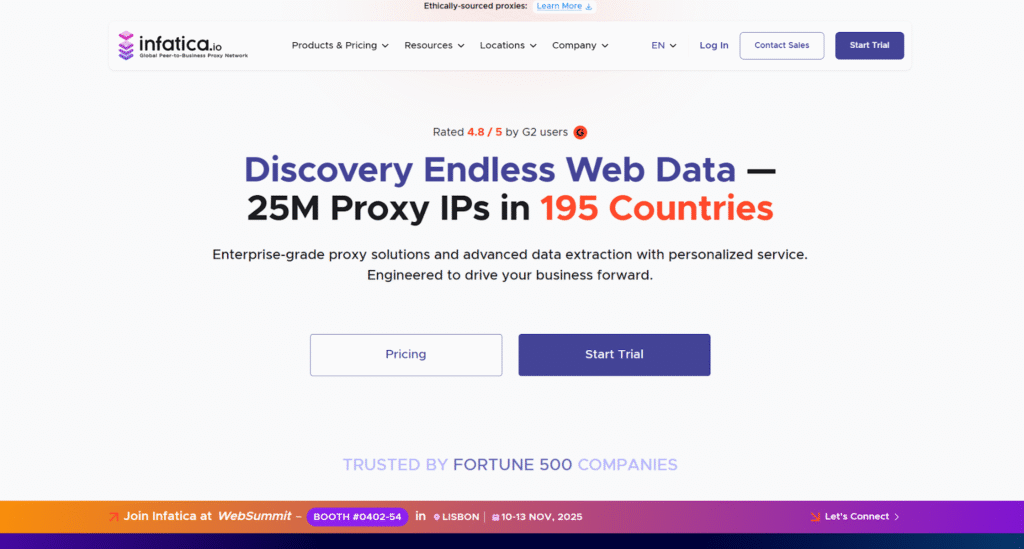
Infatica shows good speed with rotation intervals from 5 to 60 minutes and sessions up to 30 minutes. The network provides reliable connections for medium-scale scraping operations.
- Speed: Sub-2s response times
- Rotation: Flexible 5-60 minute intervals
- Session Duration: Up to 30 minutes
- IP Pool: 15M+ IPs across 100+ countries
- Pricing: Starting at $3.84/GB
15. Roundproxies
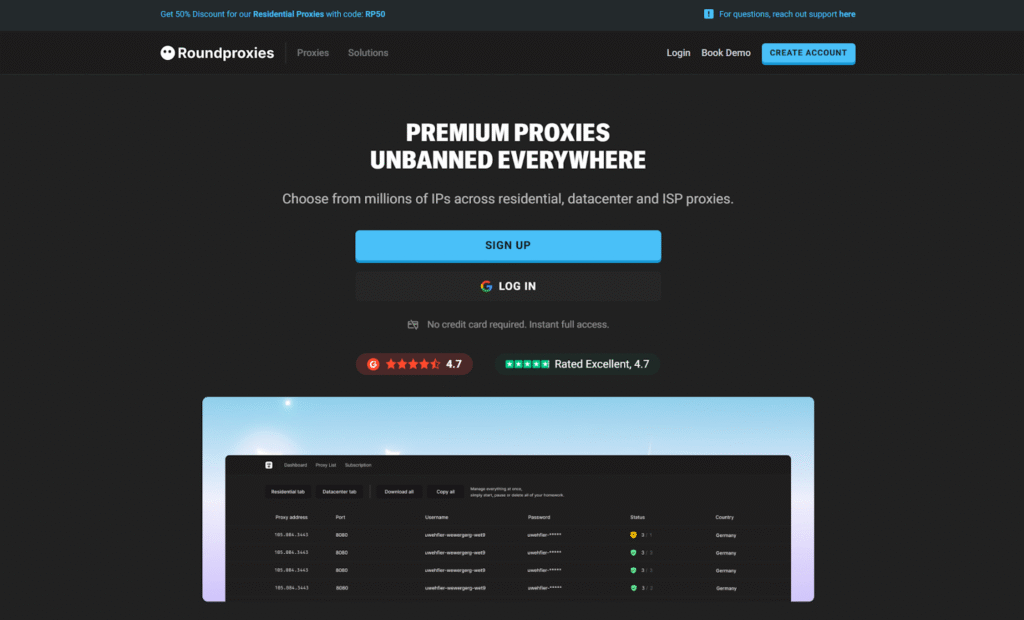
Roundproxies delivers high performance with 99.9% success rates and 119 million+ IPs using backconnect rotation technology. The platform balances speed with affordability for small to medium projects.
- Speed: Fast backconnect rotation
- Success Rate: 99.9% connection attempts
- IP Pool: 119M+ IPs globally
- Features: Automatic backconnect rotation
- Pricing: Starting at $1.50/GB
16. Thordata
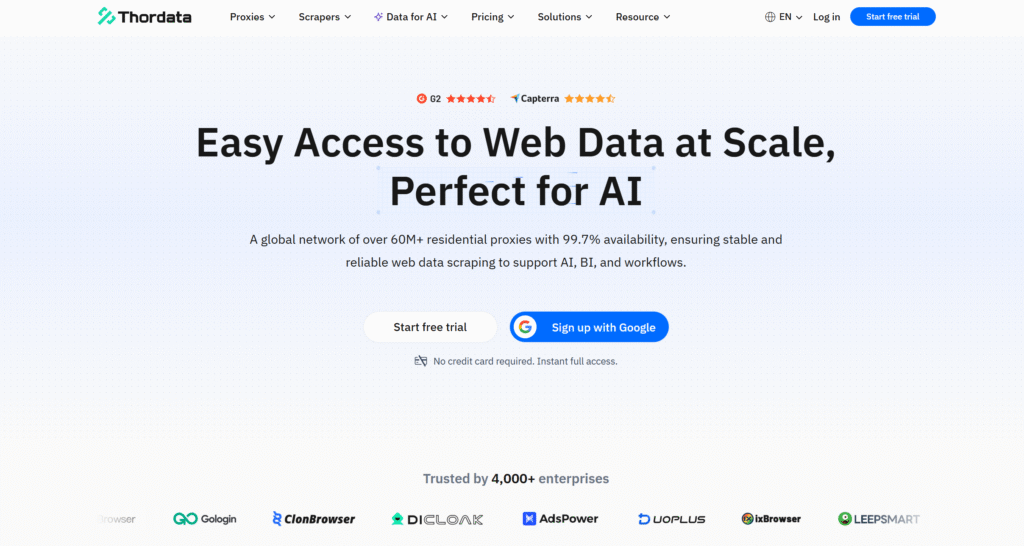
Thordata ranks among the fastest residential proxy providers in 2026 benchmarks, with optimized datacenter and mobile proxies delivering sub-second response times across high-volume scraping operations. The service offers rotating residential proxies with HTTP(S) and SOCKS5 support, achieving 99%+ uptime through direct ISP partnerships that minimize routing hops. Thordata targets data teams running real-time price monitoring and SERP scraping where milliseconds determine competitive edge. Its infrastructure emphasizes throughput and low latency over massive pool size, making it efficient for speed-critical workflows.
Key features:
- Sub-second residential proxy response times
- HTTP(S) and SOCKS5 with direct ISP routing
- 99%+ uptime for high-volume operations
- Optimized for real-time monitoring and scraping
Pros: Extremely fast for residential, high throughput, ISP partnerships Cons: Smaller focus on pool size than volume leaders
17. Proxying.io
Proxying.io leads 2026 rotating proxy speed rankings with infrastructure optimized for SEO SERP scraping and real-time data collection, delivering response times under 0.8 seconds through automatic rotation management. The developer-first platform supports HTTP(S) and SOCKS5 with API-driven rotation that maintains consistent high speeds across global targets. Proxying.io excels in keyword monitoring and competitor analysis where speed enables more frequent, accurate SERP captures. Its automatic proxy selection prevents slowdowns from degraded IPs.
Key features:
- Sub-0.8s response times for rotating proxies
- API-driven automatic rotation management
- HTTP(S) and SOCKS5 protocol support
- Optimized for SEO and real-time SERP data
Pros: Leading rotation speed, developer API, prevents IP slowdowns Cons: Rotation-focused, less static session emphasis
18. MarsProxies
MarsProxies delivers blazing-fast datacenter and residential proxies with SOCKS5 support, achieving sub-second connections across 1M+ premium IPs in 190 countries. The quality-focused pool maintains consistent performance for sneaker copping and e-commerce monitoring where milliseconds separate success from failure. MarsProxies offers customizable rotation for speed-critical operations, supporting unlimited bandwidth plans that prevent throttling during peak loads. It targets users prioritizing performance over pool volume.
Key features:
- Sub-second SOCKS5 connections across 1M+ IPs
- Customizable rotation for speed-critical tasks
- Unlimited bandwidth prevents throttling
- Optimized for e-commerce and time-sensitive operations
Pros: Blazing fast SOCKS5, quality over quantity, unlimited bandwidth Cons: Smaller premium pool than massive networks
19. Scrapingdog
Scrapingdog provides datacenter proxies optimized for web scraping speed, integrating proxy rotation with built-in scraping APIs that achieve sub-1s response times across protected targets. The service supports high-concurrency scraping with JavaScript rendering, making it ideal for dynamic SERPs and e-commerce sites that require both speed and browser simulation. Scrapingdog’s infrastructure bypasses many anti-bot measures through intelligent proxy selection and header management. It appeals to developers building custom scrapers where integrated speed matters.
Key features:
- Sub-1s scraping API with proxy rotation
- JavaScript rendering for dynamic content
- High-concurrency support with anti-bot bypass
- Integrated proxy and scraping solution
Pros: Integrated speed + anti-bot bypass, developer-friendly, dynamic content support Cons: Scraping-focused rather than raw proxy speed
20. Webshare
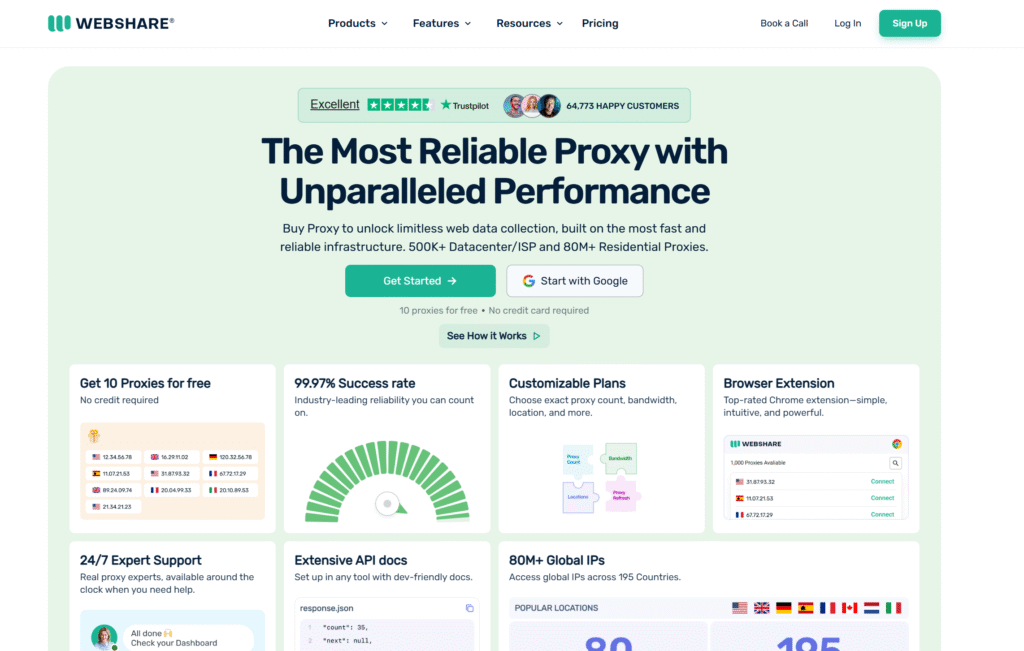
Webshare is a strong budget-friendly addition for speed-focused users because its residential proxy page highlights a fast and reliable network with industry-leading 99.7% uptime, while its homepage also promotes rotating proxy support and multiple proxy product types. It fits users who want affordable residential speed for scraping, monitoring, and lighter automation without paying enterprise pricing.
Speed: Fast and reliable residential network with 99.7% uptime. Pricing: Starts at $3.50 per month for 1GB of residential traffic. Proxy Types: Residential, static residential, and datacenter proxies. Best For: Budget-conscious scraping, basic monitoring, and entry-level automation.
21. Rayobyte
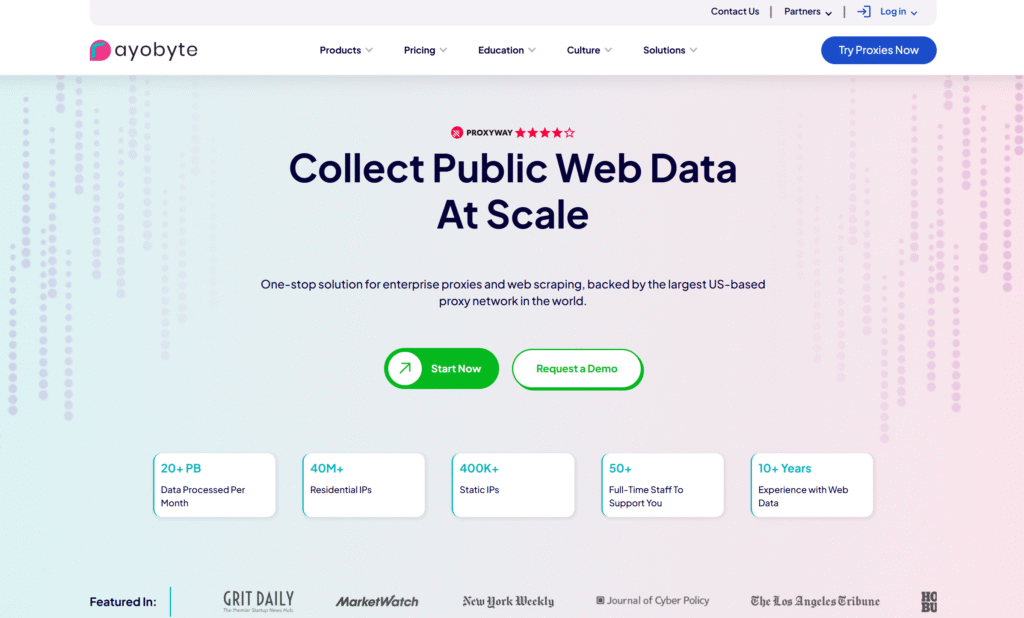
Rayobyte positions its residential proxies around reliability, low ban rates, and fast performance, and its official product page says they connect easily with tools like Selenium, Puppeteer, and Multilogin without extra configuration. Third-party review coverage also describes Rayobyte as offering residential, ISP, datacenter, and mobile proxies with a 40 million IP pool and browser extension plus API access. That makes it a practical fit for teams that care about smooth integration and stable performance as much as raw speed.
Performance: Fast, reliable residential proxy performance with low-friction setup for automation tools IP Pool: 40 million IPs according to review coverage. Tools: Works with Selenium, Puppeteer, and Multilogin; browser extension and API support are also noted in review coverage. Best For: Automation workflows, account management, and teams that want simple setup.
22. Geonode
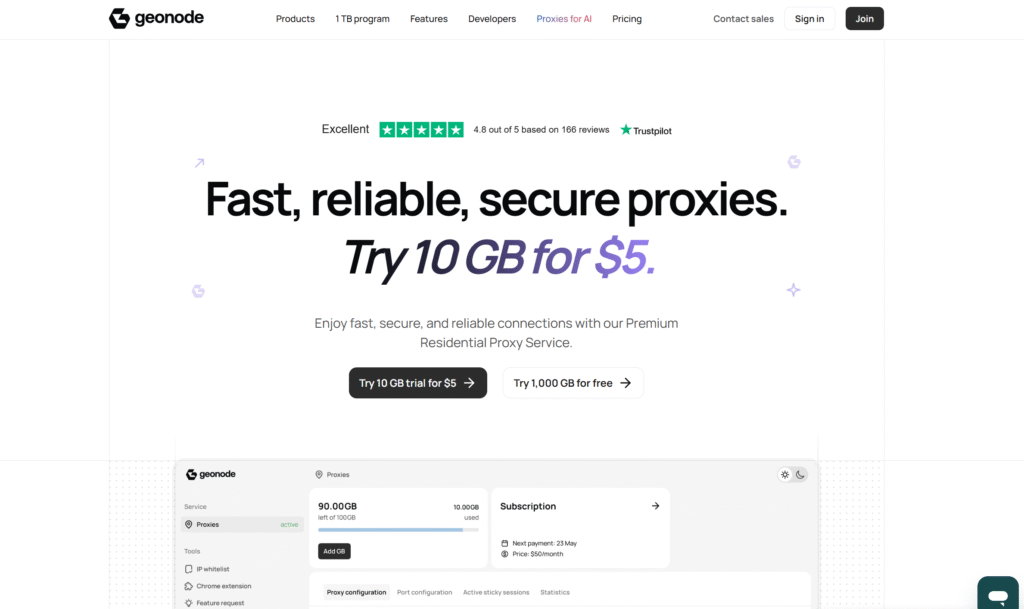
Geonode is another useful addition because its feature pages describe a premium residential proxy service built for fast, secure, and reliable connections. Its controls also include country, city, and state targeting, protocol selection between HTTPS and SOCKS5, and configurable session type and duration. That flexibility makes it a solid option for users who want to tune speed, routing, and session behavior for different scraping workloads.
Performance: Fast, secure, and reliable residential proxy service. Controls: Country, city, and state targeting with HTTPS or SOCKS5 selection. Session Options: Configurable session type and duration through port-level settings. Best For: Region-specific scraping, configurable routing, and mixed automation workflows.
23. Nimble
Nimble stands out as one of the fastest residential proxy additions because its residential proxy page says requests average 0.25 seconds, with AI-driven routing, geotargeting, and auto-scaling infrastructure. Another Nimble page also says the service offers 0.25-second median response time, unlimited concurrent requests, 99.9% performance average, and support for longer location-based sessions. For speed-critical data collection, that puts Nimble firmly in the premium tier.
Speed: 0.25-second average or median response time, depending on page context. Concurrency: Unlimited concurrent requests. Optimization: AI-driven routing and intelligent IP selection on every request. Best For: High-speed scraping, AI data workflows, and large-scale real-time extraction.
24. Massive
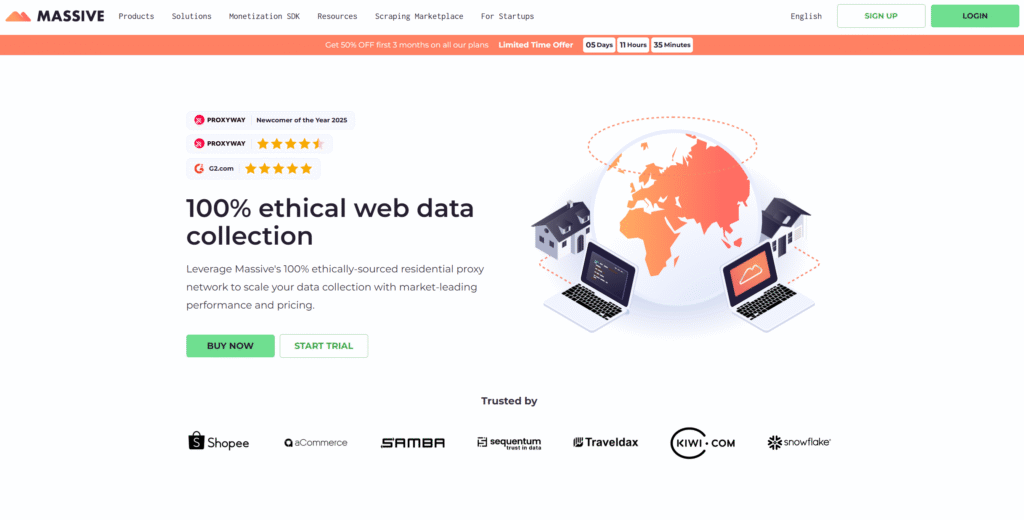
Massive deserves a spot here because its residential proxy page highlights 0.52-second response times in the US and EU, a 99.87% success rate, and support for HTTP, HTTPS, and SOCKS5 across 195+ countries. The same page says its ethically sourced network includes 1.6 million plus IPs with advanced country, state, city, ZIP, and ASN targeting. That makes Massive especially appealing for users who want a mix of speed, clean sourcing, and granular targeting rather than just a giant headline IP pool.
Speed: 0.52-second response time in the US and EU. Success Rate: 99.87% on residential traffic. IP Pool: 1.6 million plus IPs across 195+ countries. Best For: Fast geo-targeted scraping, SEO monitoring, ad verification, and market research.
Fast Proxies for Real-Time Competitive Intelligence
Real-time competitive intelligence operations in 2026 demand proxy speeds under 1 second to capture pricing, inventory, and SERP shifts before competitors react. ISP proxies like NetNut achieve 0.46–1.0s response times with residential trust, powering price monitoring across Amazon, Walmart, and regional marketplaces where 100ms differences determine profitability. Rotating residential proxies from Oxylabs (0.41s) and Decodo (0.63s) maintain 99%+ success rates during sneaker copping and flash sale monitoring. proxyway
Mobile proxies from 4G/5G networks deliver 0.5–1.5s speeds with maximum platform trust for TikTok and Instagram trend monitoring, where algorithms heavily penalize non-carrier IPs. SOCKS5 protocol support — standard across top providers — maximizes speed for Python Scrapy frameworks and Node.js scrapers processing live SERP data.
Proxy Speed Testing Methodologies and Benchmarks
Accurate proxy speed evaluation requires standardized testing across real targets rather than generic ping tests. Independent 2026 benchmarks measure Average Time to Successful Response (ATSR) over 10,000+ requests per provider, calculating standard deviation to quantify consistency — Oxylabs leads at 0.41s ATSR with 0.12s deviation, while residential averages 0.8–1.5s. Success Rate under Load tests 95%+ connections during 1,000 concurrent threads, where NetNut (99%) and SOAX (98.5%) excel. Concurrent Throughput measures sustained requests per second — premium providers handle 500–2,000 RPS without degradation, critical for high-volume scraping. Geo-Specific Latency verifies city-level targeting accuracy, as US East Coast proxies to West Coast targets average 50–100ms higher latency than local ISP routing. Always validate claims with your specific targets using trial credits from Decodo (100MB free) or IPRoyal (pay-as-you-go).
Performance Benchmarking Methods
Independent testing organizations measure proxy speed using automated scripts across multiple data centers to eliminate location bias. Key metrics include average time to successful response (ATSR), standard deviation of response time (SDSRT), and upper bound calculations for 68% of requests.
Recent benchmarks from 2024 Q4 show response times ranging from 2 to 6 seconds with standard deviations between 2 to 17 seconds across major providers. The fastest residential proxy providers consistently achieve response times below 1.2 seconds under high-load conditions with hundreds of thousands of requests per hour. Testing also evaluates sustained throughput, connection stability, and success rates across both easy-to-scrape and protected domains.
How to Choose Fast Proxies
Selecting the fastest proxy depends on your specific use case. For SOCKS5 proxies requiring maximum speed, prioritize providers with sub-0.5s response times and ISP-level infrastructure. Web scraping projects benefit from rotating residential proxies with 85-95% success rates even if response times reach 1-2 seconds.
Consider concurrent session limits, bandwidth allocation, and geographic targeting options. Premium providers offer unlimited threads and city-level targeting, while budget options may restrict concurrent connections. Test proxy performance in your target locations since response times vary significantly by geography. Look for providers offering free trials or money-back guarantees to validate speed claims before committing to long-term plans.
What speed really means
Proxy speed is usually described as how quickly requests are sent and completed, but that is only one part of performance. Latency, connection stability, and request success rate also matter because a proxy that fails often can waste more time than a slightly slower one.
This becomes especially important when comparing residential rotating proxies vs residential proxies, since different session patterns can change how fast a proxy feels in practice. For many workflows, the real issue is not just speed, but whether the proxy stays usable long enough to complete the job.
Why test by use case
The fastest proxy for one workflow is not always the fastest for another. Speed matters differently for scraping, price monitoring, SERP tracking, and browser-based account work.
If your task depends on high-volume requests, it makes sense to look at what are high-volume scraping proxies and compare them with residential mobile proxies for web scraping or residential mobile proxies for SERP scraping. If your task depends on stable sessions rather than bulk speed, then session-based setup matters more than headline latency.
Key speed factors
Several factors affect real proxy speed, including network distance, server load, IP type, and rotation behavior. A proxy may also feel slower if the target site is strict, heavily monitored, or frequently changing its defenses.
That is why it helps to separate speed claims from session behavior and compare them with what are sticky proxies and what are session-based proxies. For users who need reliable browsing and account workflows, mobile proxies vs residential proxies can also be a useful comparison.
How to test claims
The cleanest way to test proxy speed is to use the same task, same target, and same timeframe across all proxies. Then compare response time, success rate, retries, and block frequency instead of relying on a single benchmark.
For speed-sensitive scraping and monitoring, residential mobile proxies for price monitoring, residential mobile proxies for market research, and residential mobile proxies for SERP data analysis connect speed claims to real workloads instead of treating every proxy test as identical.
Fast proxies by use case
For real-time pricing, search visibility, and product tracking, speed matters most when data freshness matters too. In those cases, fast proxies only help if they also stay stable enough to avoid retries and delays.
For account and browser-based workflows, stable fast sessions are often more useful than the absolute fastest proxy. BitBrowser, the multi-account browser built for scale, and best sticky residential proxies are relevant for readers who care about session continuity.
FAQ
Do fast residential proxies help with SERP tracking?
Yes, fast residential proxies can help with SERP tracking because they support frequent ranking checks and fresh search-result collection. That matters when timing is important and you need current data rather than delayed results. They are most useful when paired with tools and workflows designed for search monitoring. Residential mobile proxies for SERP scraping and residential mobile proxies for SERP data analysis are natural next steps for readers building out their monitoring setup.
Should I use SOCKS5 for speed-sensitive proxy tools?
SOCKS5 can be a good fit for speed-sensitive tools because it works well in many automation and scraping setups. It is often chosen when flexibility and transport handling matter as much as raw speed. What are SOCKS5 proxies explains that angle more clearly. You can also explore best SOCKS5 proxy service providers if you’re looking for specific provider options.
Are rotating proxies always faster than sticky sessions?
No, rotating proxies are not always faster than sticky sessions. Rotation can help spread requests and reduce some blocks, but it can also create overhead if your workflow needs a consistent identity. What are rotating proxies, what are sticky proxies, and rotating proxies vs static proxies make the difference between speed and session consistency much easier to understand.
What matters more for fast scraping: latency or success rate?
For real scraping jobs, success rate often matters more than raw latency. A proxy with low latency but frequent failures can end up slower overall because retries and blocked requests waste time. What are high-volume scraping proxies and residential mobile proxies for web scraping help connect proxy speed to actual scraping performance instead of just milliseconds.
Can mobile proxies be fast enough for real-time monitoring?
Yes, mobile proxies can be fast enough for real-time monitoring when authenticity matters as much as speed. They are especially useful when the target site responds better to mobile traffic than to datacenter traffic. What are mobile proxies is the best primer for understanding why. You can also compare mobile proxies vs residential proxies and review best mobile proxy providers for 2025 to evaluate your options.
What makes a proxy fast?
Proxy speed depends on network infrastructure, routing optimization, and geographic proximity to target servers. The fastest proxies use direct ISP connections, AI-powered routing, and distributed server networks to minimize latency. Response times under 1 second typically indicate high-performance infrastructure with optimized pathways and minimal intermediary hops between your requests and target websites.
Are faster proxies more expensive?
Not always. While premium providers like Oxylabs and Bright Data charge $3-5 per GB for sub-second response times, affordable options like DataImpulse and Roundproxies offer competitive speeds at $1-1.50 per GB. Pricing varies based on features like concurrent sessions, targeting options, and IP pool size rather than speed alone. ISP proxies often cost more due to faster performance and higher success rates on protected sites.
Can slow proxies affect scraping accuracy?
Slow response times create timeout errors that reduce data completeness and accuracy. When proxies take 3+ seconds to respond, many websites trigger anti-bot mechanisms or return incomplete data. Projects requiring thousands of requests per hour need sub-2s response times to maintain accuracy and avoid detection. Consistent speed matters more than peak performance since variable response times appear suspicious to anti-scraping systems.
Which proxy type offers the fastest speeds?
ISP proxies deliver the fastest speeds at 100-300 Mbps with 10-50ms latency, combining datacenter performance with residential legitimacy. Datacenter proxies reach 100-1000 Mbps but face higher block rates on protected sites. Residential proxies average 10-100 Mbps with 100-300ms latency, offering better success rates despite slower speeds. Choose based on whether your project prioritizes raw speed or avoiding detection.
Ready to experience the fastest residential proxies in the industry? Start your free trial with Resiprox today and discover sub-second response times across 180+ countries with 99.9% uptime guaranteed.