

Looking for budget-friendly proxy solutions that don’t compromise on speed? Cheap datacenter proxies offer the fastest, most affordable way to handle high-volume scraping, automation, and price monitoring tasks. Unlike residential proxies that can cost several dollars per gigabyte, affordable datacenter proxies deliver server-grade speeds at a fraction of the price, making them the go-to choice for teams that need to scale without breaking the bank. Discover the Best Cheap Datacenter Proxies in 2026
Compare pricing and performance across all 19 providers below, or start with affordable datacenter proxies from ResiProx to test speeds under 0.3 seconds today.
- Why Datacenter Proxies Are the Cheapest Option (And When to Use Them)
- What to Look for in Cheap Datacenter Proxies (Without Sacrificing Quality)
- Top 19 Best Cheap Datacenter Proxies in 2026
- 1. 🏆ResiProx – Best Cheap Datacenter Proxies in 2026 🏆
- 2. Webshare
- 3. Decodo (ex-Smartproxy)
- 4. IPRoyal
- 5. Rayobyte
- 6. ProxyEmpire
- 7. DataImpulse
- 8. MarsProxies
- 9. Proxy-Seller
- 10. Proxyrack
- 11. SOAX
- 12. NetNut
- 13. SquidProxies
- 14. Proxy-Cheap
- 15. ProxyScrape
- 16. Ping Proxies
- 17. BuyPersonalProxy
- 18. PrivateProxy.me
- 19. FineProxy
- How to choose the cheapest pricing model for your workload
- When to upgrade from cheap datacenter proxies
- Shared vs Dedicated vs Rotating Datacenter Proxies: Which Is Cheapest?
- Common Mistakes When Buying Cheap Datacenter Proxies (And How to Avoid Them)
- Best Use Cases for Budget Datacenter Proxies in 2026
- FAQ
- What are the best cheap datacenter proxies in 2026?
- Are cheap datacenter proxies reliable for web scraping?
- How do datacenter proxies compare to residential proxies in cost?
- Can I use cheap datacenter proxies for social media management?
- Should I pay per IP or per GB for cheap datacenter proxies?
- Are shared datacenter proxies enough for SEO tools?
- How many datacenter proxies do I need for price monitoring?
- When do cheap datacenter proxies need SOCKS5 support?
- What is the biggest warning sign that a budget datacenter provider is too cheap?
Why Datacenter Proxies Are the Cheapest Option (And When to Use Them)
Datacenter proxies are IP addresses that come from server farms and cloud providers, not from real residential devices or internet service providers. This server-based infrastructure is what makes them so much cheaper than residential proxies or mobile proxies. When you buy datacenter IPs, you’re essentially renting server addresses that can handle massive traffic volumes at lightning-fast speeds.
Why They Cost Less
The pricing difference is simple: datacenter proxies don’t require a network of real devices or users. Providers can generate thousands of IPs from a single data center, which dramatically reduces overhead costs. This efficiency gets passed on to you as lower per-IP or per-GB pricing.
When Datacenter Proxies Work Best
These proxies excel in several scenarios:
- High-volume web scraping where you need to make thousands of requests quickly
- SEO monitoring tools that check rankings and collect search engine data
- Price monitoring across e-commerce sites and marketplaces
- Ad verification that doesn’t require residential-level anonymity
- Social media automation on platforms with lighter bot detection
- Market research and competitor analysis projects
When to Avoid Them
Datacenter proxies aren’t ideal for every task. Skip them when:
- Targeting sites with aggressive anti-bot systems (like sneaker sites or ticket platforms)
- Managing social media accounts on platforms with strict detection (Instagram, Facebook)
- Accessing streaming services that block datacenter IPs
- Running campaigns where residential authenticity is required
For most scraping and automation workflows, though, cheap datacenter proxies deliver excellent value.
What to Look for in Cheap Datacenter Proxies (Without Sacrificing Quality)
Not all budget proxies are created equal. Here’s what separates reliable providers from ones that’ll waste your time and money.
Shared vs Dedicated vs Rotating Options
Shared proxies are the cheapest option, you split IP addresses with other users, which works fine for basic tasks but increases the risk of blocks if someone else abuses the IP. Dedicated proxies give you exclusive access to specific IPs, offering better control and lower block rates at a slightly higher price. Rotating proxies automatically switch IPs with each request or at set intervals, perfect for large-scale scraping where you need fresh addresses constantly.
IP Pool Size and Refresh Rates
Bigger isn’t always better, but a decent pool size (at least 10,000+ IPs) gives you more rotation options. Check how often the provider refreshes banned or flagged IPs, weekly or monthly refreshes help maintain pool quality.
Location Coverage That Matches Your Needs
Don’t pay for global coverage if you only scrape US sites. Focus on providers with strong presence in your target countries. City-level targeting is a bonus for localized data collection.
Speed and Uptime Guarantees
Budget providers should still deliver sub-second response times and 99%+ uptime. Anything slower than 1-2 seconds will bottleneck your scraping operations. Look for providers that publish their performance metrics.
Bandwidth Policies
Unlimited bandwidth is common with datacenter proxies and eliminates surprise overage charges. If a provider meters bandwidth, calculate your expected usage to avoid paying residential-level per-GB rates.
Authentication Methods
Most datacenter proxies support IP whitelisting (you add your server’s IP to an allowlist) or username:password authentication. IP whitelisting is faster but less flexible if you work from multiple locations.
API and Dashboard Quality
You’ll spend time in the provider’s dashboard generating endpoints, monitoring usage, and managing IPs. A clean interface with API access for automation saves hours of manual work.
Pricing Models: Per-IP vs Per-GB
Per-IP pricing works best when you need dedicated or semi-dedicated IPs for specific tasks. Per-GB pricing makes sense for rotating proxies where you care more about total traffic than specific addresses. Calculate your cost per task to find the better deal.
Support Quality Matters
Even cheap providers should offer basic support. Check if they have documentation, live chat, or email support for technical issues.
Top 19 Best Cheap Datacenter Proxies in 2026
1. 🏆ResiProx – Best Cheap Datacenter Proxies in 2026 🏆
Resiprox Premium Proxies – Unlock the Web with Power and Precision
Introducing Resiprox, the ultimate proxy solution designed to supercharge your online operations. With our Residential Proxies and Mobile Proxies, you get unmatched access to web data at scale, robust security, and seamless connectivity all backed by a free trial to experience the difference firsthand.
Product Features
- Rotating Residential Proxies: Harness the power of 10M+ ethically-sourced IPs across 180+ countries. These proxies rotate dynamically to bypass IP blocks, CAPTCHAs and delivering 99.9% uptime and precise targeting at the country, city, or ZIP code level.
- Rotating Mobile Proxies: Powered by 4G/LTE/5G networks, our mobile proxies offer lightning-fast speeds with <0.3s response times and a 99.9% success rate perfect for real-time applications.
- Global IP Network: Tap into millions of IPs, including 3.5M+ in the US, 1.8M+ in Brazil, 3.1M+ in India, and more, ensuring coverage wherever you need it.
- Advanced Capabilities: Enjoy HTTPS & SOCKS5 support, unlimited concurrent sessions, and flexible rotating or sticky sessions, all wrapped in premium IP quality.
Product Specifications:
- Performance: High-speed browsing with 99.9% uptime and 24/7 expert support.
- Integration: Seamlessly works with Node.js, Python, PHP, Selenium, and more, featuring a dynamic endpoint generator and robust API access.
What It’s Built For:
Resiprox proxies are your all-in-one tool for:
- Web Scraping: Extract public data effortlessly for insights and growth.
- Price Monitoring: Track prices across regions in real-time.
- Multi-Accounting: Manage multiple accounts without limits.
- SEO & Ad Verification: Monitor rankings and verify ads globally.
- Cybersecurity: Protect your brand and test applications securely.
- Specialized Tasks: From sneaker botting to travel fare aggregation, Resiprox delivers.
Why Resiprox Stands Out:
This isn’t just a proxy, it’s a game-changer. With comprehensive documentation, multi-platform compatibility, and a team of experts available 24/7, Resiprox ensures your projects run smoothly. Whether you’re a business scaling operations, a researcher gathering data, or a developer testing apps, our proxies adapt to your needs with precision and reliability.
Resiprox Premium Proxies – Your Key to a Smarter, Faster, and More Connected Online World.
Click here to discover our :
2. Webshare
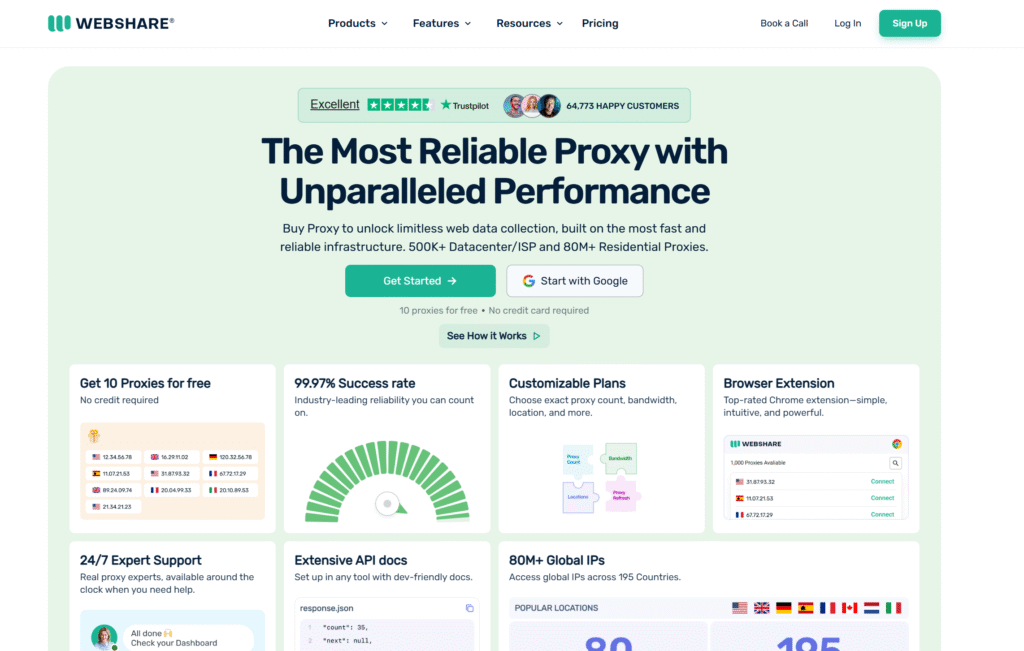
Webshare has built a reputation as one of the most budget-friendly datacenter proxy providers, with plans starting around $0.03 per IP. They offer shared, private, and dedicated proxy options across 40+ countries, giving you flexibility based on your use case and budget. The platform includes a free tier with 10 IPs, perfect for testing before committing to a paid plan.
Key features:
- Shared and dedicated datacenter proxies
- 40+ country coverage with city-level targeting
- Unlimited bandwidth on most plans
- Customizable rotation settings
- Free tier with 10 IPs for testing
Pros:
- Extremely affordable entry point for new users
- Fast setup and clean dashboard interface
- Good performance for medium-scale scraping
- Flexible rotation controls
Cons:
- Shared IPs may have higher block rates on strict sites
- Smaller pool compared to premium providers
3. Decodo (ex-Smartproxy)
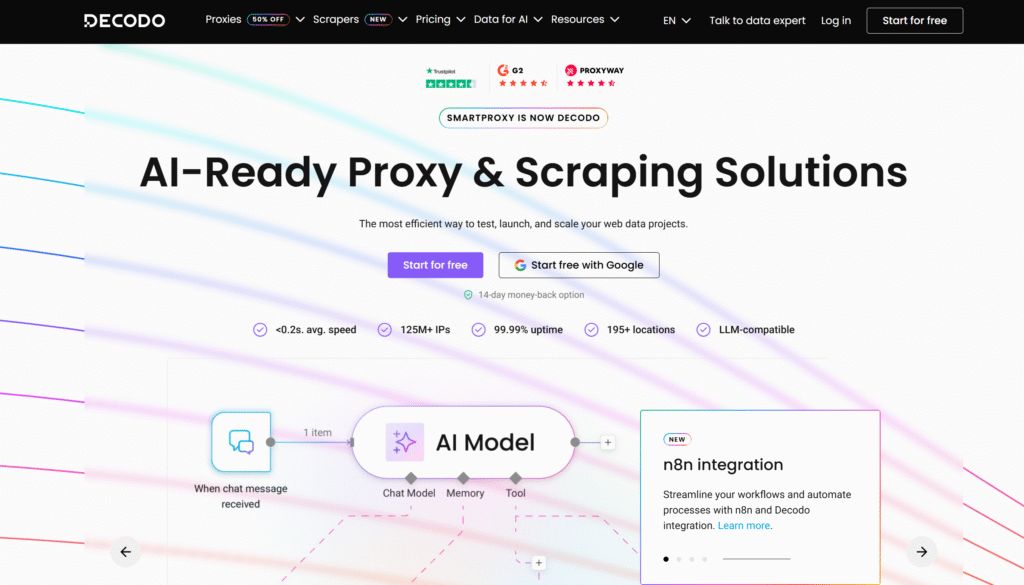
Decodo (formerly Smartproxy) provides affordable, high-performance datacenter proxies specifically optimized for web scraping. Their 100,000+ IP pool covers primarily US and European locations with shared and dedicated options. The platform delivers sub-second speeds and maintains a strong success rate for most scraping targets.
Key features:
- 100K+ datacenter IPs in US and EU
- Both shared and dedicated IP options
- Flexible pay-per-IP or per-GB pricing models
- Fast response times for quick scraping
- Dashboard with usage analytics
Pros:
- Strong balance between price and performance
- Reliable uptime for consistent scraping
- Good documentation and onboarding
- Flexible pricing accommodates different budgets
Cons:
- More limited global coverage than some competitors
4. IPRoyal
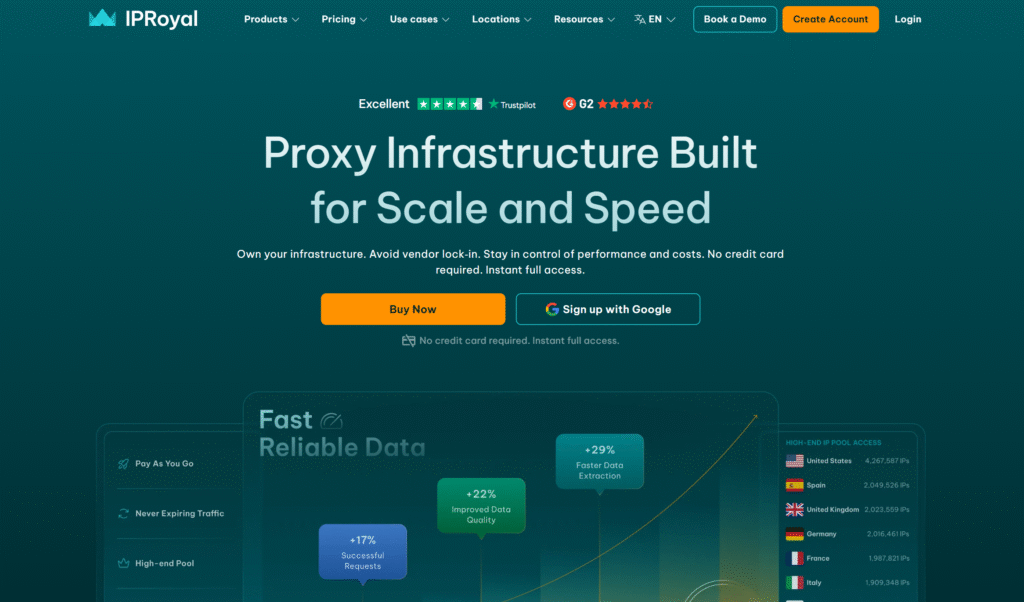
IPRoyal specializes in cost-effective dedicated datacenter proxies starting at $1.39 per IP with significant bulk discounts. They cover 60+ locations worldwide and include unlimited threads and traffic with every plan. IPs refresh monthly to maintain pool quality, and you can manage everything through their API.
Key features:
- Dedicated datacenter proxies from $1.39/IP
- 60+ global locations
- Unlimited threads and bandwidth
- Monthly IP refreshes
- API management for automation
Pros:
- Very affordable dedicated IPs for small-scale projects
- Bulk pricing drops costs further
- No restrictions on concurrent connections
- Simple setup process
Cons:
- Better suited for smaller operations than enterprise-scale
5. Rayobyte
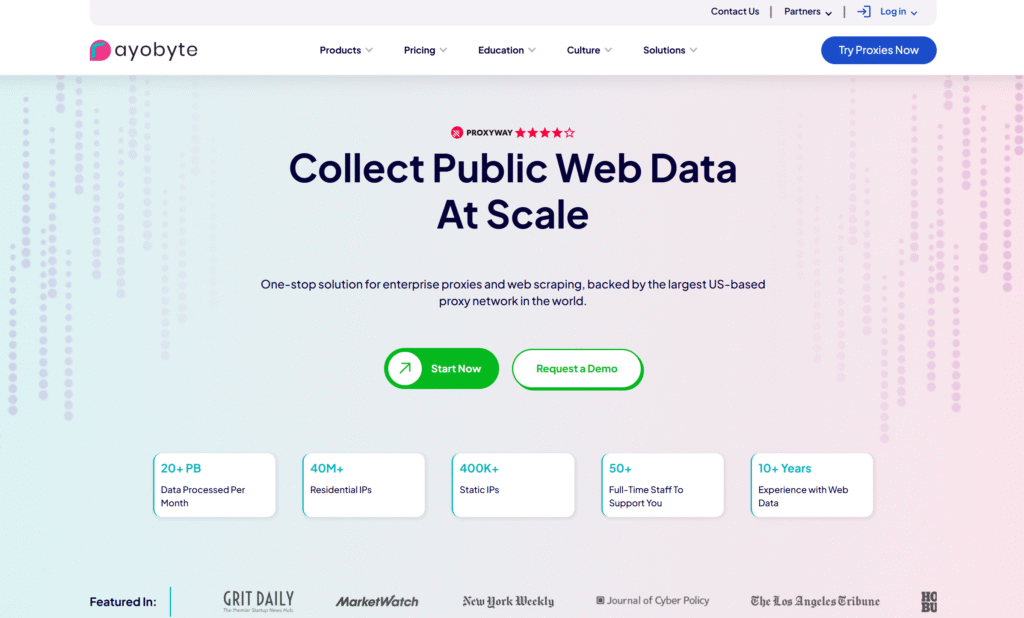
Rayobyte offers reliable, mid-tier datacenter proxies with shared, dedicated, and rotating options. Their 300,000+ IP pool spans 27 countries with no limits on threads or target domains. The platform provides city-level targeting and maintains strong uptime, making it versatile enough for scraping, automation, and enterprise tasks.
Key features:
- 300K+ IPs across 27 countries
- Shared, dedicated, and rotating proxy types
- Unlimited threads and domains
- City-level location targeting
- Strong uptime guarantees
Pros:
- Diverse proxy types for different use cases
- Large IP pool with good geographic spread
- No artificial restrictions on usage
- Reliable performance across use cases
Cons:
- Mid-tier pricing slightly higher than ultra-budget options
6. ProxyEmpire
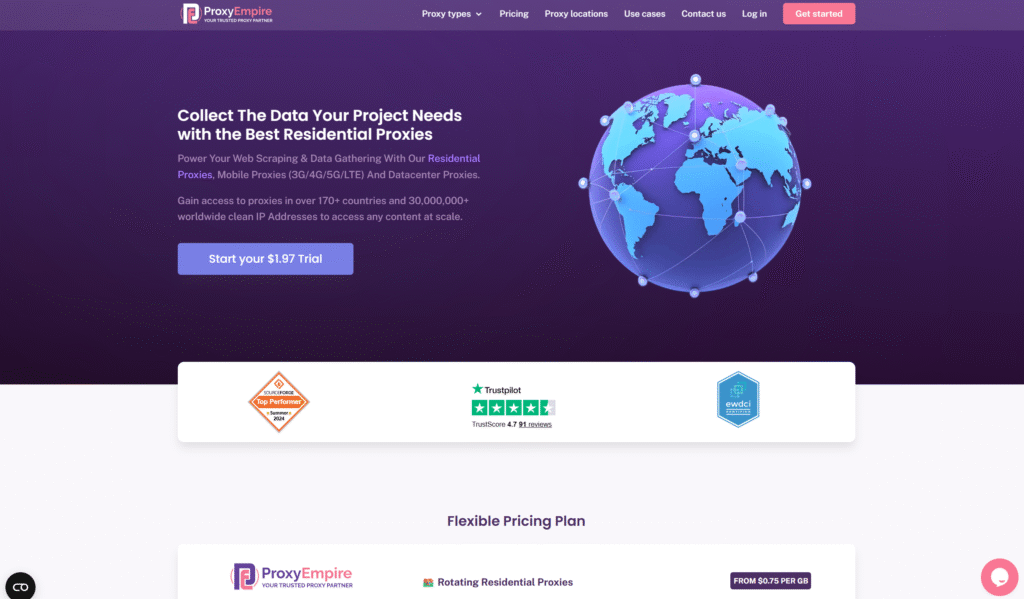
ProxyEmpire provides affordable rotating datacenter proxies with 40,000+ clean IPs covering 170+ countries. They offer a low-barrier $1.97 trial to test the service before scaling up. With 99.9% uptime and low latency around 0.6 seconds, the platform handles data collection tasks efficiently while maintaining ethical sourcing practices.
Key features:
- 40K+ datacenter IPs in 170+ countries
- Rotating proxy infrastructure
- $1.97 trial option
- 99.9% uptime guarantee
- Low 0.6s average latency
Pros:
- Very affordable trial for testing
- Broad global coverage
- Ethical IP sourcing practices
- Fast speeds for budget tier
Cons:
- Smaller pool than premium providers
7. DataImpulse
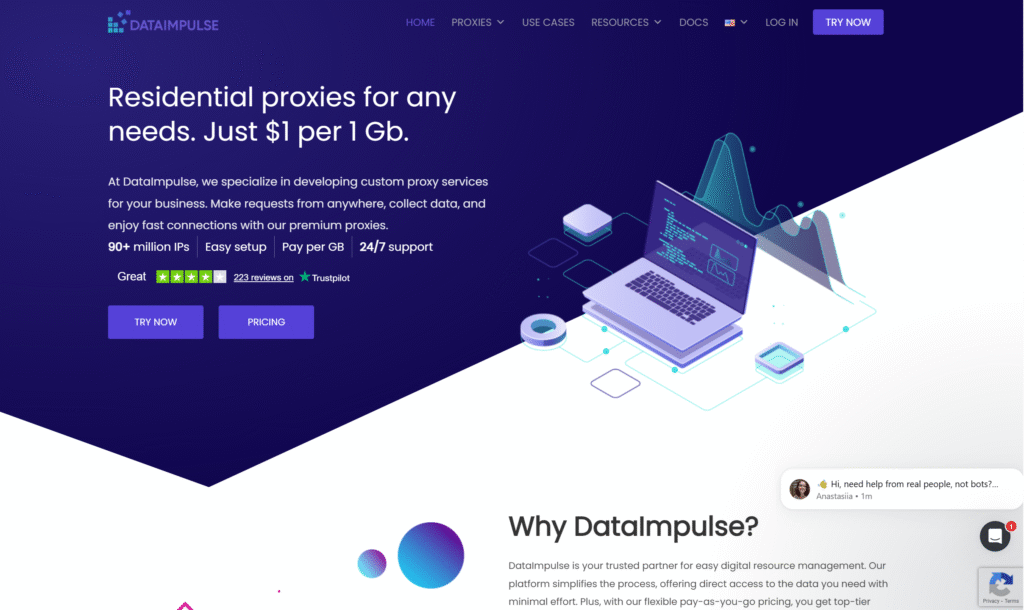
DataImpulse offers cheap per-GB rotating datacenter proxies with coverage across 100+ countries. Their platform supports precise ASN and city-level targeting, giving you granular control over your proxy locations. The service emphasizes high IP diversity and fast connection speeds, making it suitable for budget-conscious scraping where flexibility matters.
Key features:
- Per-GB pricing model for rotating proxies
- 100+ country coverage
- ASN and city targeting options
- High IP diversity in rotation
- Fast connection speeds
Pros:
- Flexible location targeting
- Pay-per-GB works well for variable workloads
- Good IP rotation diversity
- Affordable for high-volume scraping
Cons:
- Per-GB costs can add up for extremely heavy usage
8. MarsProxies
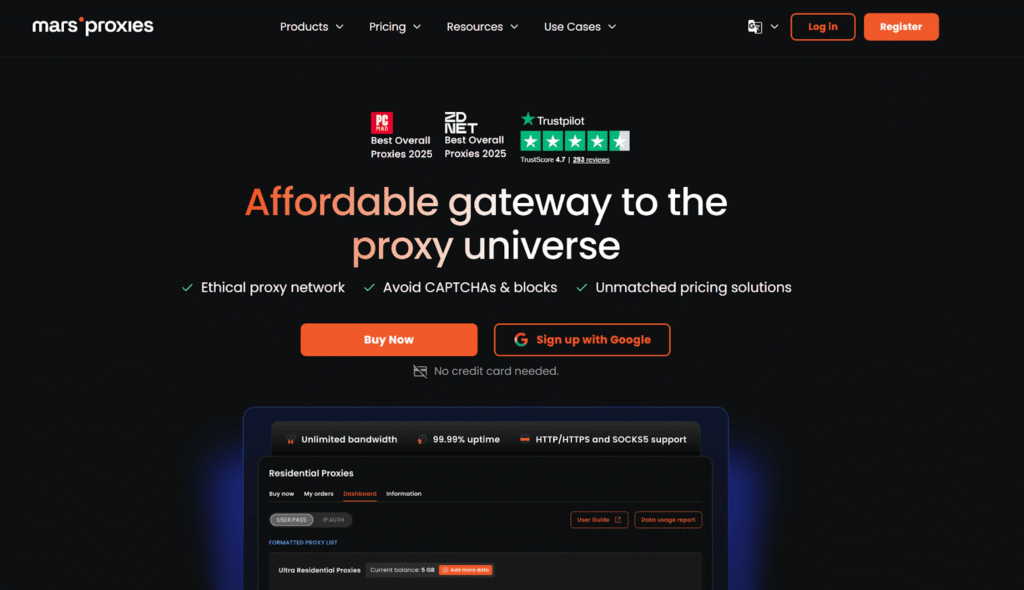
MarsProxies delivers budget datacenter proxies starting at $1.98 per IP with unlimited bandwidth included. Their dedicated proxy options span 30 countries with response times under 0.5 seconds and 99.99% uptime claims. The service is optimized for scraping, bot operations, and price monitoring where speed and reliability matter.
Key features:
- Dedicated datacenter proxies from $1.98/IP
- 30 country coverage
- Unlimited bandwidth per IP
- Sub-0.5s response times
- 99.99% uptime target
Pros:
- Very affordable dedicated IP pricing
- Fast speeds for time-sensitive scraping
- No bandwidth restrictions
- Optimized for automation tasks
Cons:
- Smaller geographic coverage than global providers
9. Proxy-Seller
Proxy-Seller offers reasonably priced dedicated datacenter proxies with a flexible purchase model, you can buy from just 1 IP up. They provide global coverage across 5 continents with weekly or monthly IP refresh options. The low per-IP costs for bulk purchases make them appealing for targeted automation on tight budgets.
Key features:
- Dedicated datacenter proxies, buy from 1 IP
- Global coverage across 5 continents
- Weekly or monthly IP refreshes
- Low bulk pricing
- Flexible purchase quantities
Pros:
- No minimum purchase requirements
- Good for small, targeted projects
- Bulk discounts available
- Regular IP refreshes maintain quality
Cons:
- Better for focused tasks than massive-scale scraping
10. Proxyrack
Proxyrack provides simple, cheap shared and private datacenter proxies with fast setup and minimal configuration. They maintain 99% uptime with support for both HTTP and SOCKS5 protocols. The platform scales easily for most tasks, making it a favorite among beginners and users running light automation workflows.
Key features:
- Shared and private datacenter options
- HTTP and SOCKS5 protocol support
- 99% uptime
- Fast account setup
- Easy scalability
Pros:
- Very beginner-friendly interface
- Quick setup without complex configuration
- Affordable entry-level pricing
- Good for light automation needs
Cons:
- Basic features compared to advanced providers
11. SOAX
SOAX offers value-packed shared and dedicated datacenter proxies starting at $0.40 per GB for bulk purchases. They maintain 99.9% uptime with city-level targeting available in key regions. The service balances price and performance well, making it suitable for mid-volume scraping operations that need reliability without premium costs.
Key features:
- Shared and dedicated datacenter proxies
- From $0.40/GB with bulk pricing
- 99.9% uptime guarantee
- City-level targeting in major regions
- Good for mid-volume use
Pros:
- Competitive bulk pricing
- Reliable uptime for consistent operations
- Location targeting flexibility
- Good price-to-performance ratio
Cons:
- Limited to key regions for city targeting
12. NetNut
NetNut provides affordable datacenter proxies at approximately $0.50 per GB with a 150,000+ IP pool spanning 200+ countries. The platform supports unlimited concurrent connections and offers enterprise-grade targeting options. This combination makes it suitable for teams looking to scale scraping operations without jumping to premium-tier pricing.
Key features:
- 150K+ IPs in 200+ countries
- Per-GB pricing around $0.50
- Unlimited concurrent connections
- Enterprise-grade location targeting
- Large global IP pool
Pros:
- Extensive country coverage
- No concurrency limits
- Advanced targeting capabilities
- Good for scaling operations
Cons:
- Per-GB pricing requires careful usage monitoring
13. SquidProxies
SquidProxies offers scalable, low-cost datacenter proxies with prices dropping to $0.91 per IP when you purchase 1,000+ addresses. Their 1 million+ IP pool covers 40+ countries with unlimited threads and 99.99% uptime claims. This makes them a solid budget option for projects requiring large volumes of dedicated IPs.
Key features:
- 1M+ IP pool across 40+ countries
- Bulk pricing to $0.91/IP for 1K+
- Unlimited threads per proxy
- 99.99% uptime target
- Large-scale dedicated options
Pros:
- Excellent bulk pricing for high-volume needs
- Large IP pool for rotation
- No thread restrictions
- Strong uptime claims
Cons:
- Best value requires larger IP commitments
14. Proxy-Cheap

Proxy-Cheap lives up to its name as one of the most affordable datacenter options at around $0.30 per IP. They cover 127+ countries with both rotating and shared proxy plans, plus they offer residential proxies for users who need both types. This makes them a top pick for entry-level users and ultra-budget scraping projects.
Key features:
- Datacenter proxies from $0.30/IP
- 127+ country coverage
- Rotating and shared proxy options
- Also offers residential proxies
- Multiple proxy types available
Pros:
- Among the cheapest per-IP pricing available
- Wide country selection
- Good for testing and small projects
- Flexible proxy type options
Cons:
- Performance may vary on ultra-cheap shared plans
15. ProxyScrape
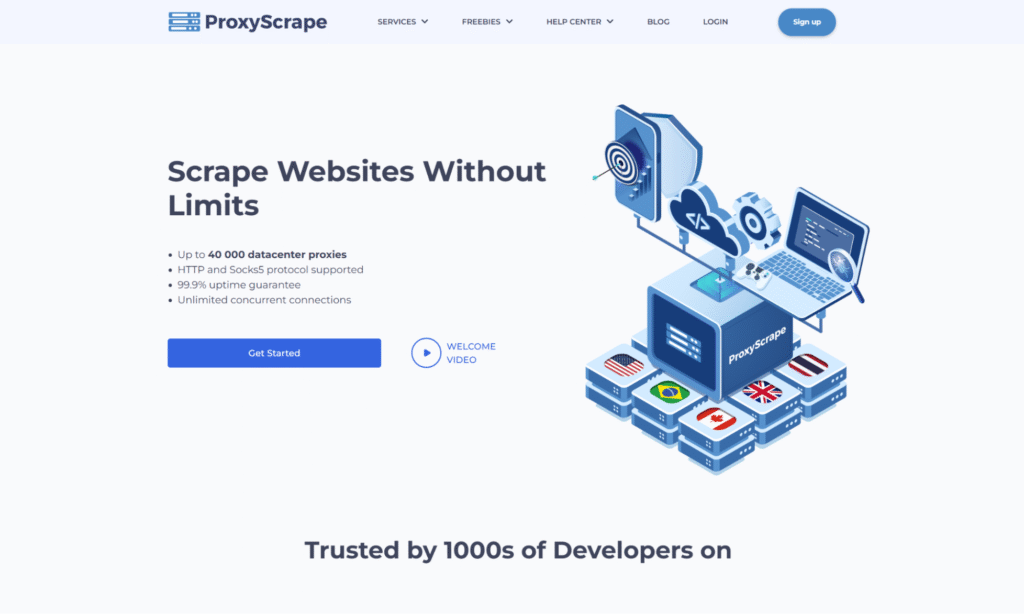
ProxyScrape is a strong low-cost datacenter option for teams that want simple scaling and high-volume shared pools. The company says it offers up to 40,000 datacenter proxies with HTTP and SOCKS5 support, unlimited concurrent connections, and unlimited bandwidth for its datacenter products. Its lineup also separates shared datacenter plans from dedicated static plans, which makes it useful for both bulk scraping and steadier long sessions.
Key features: up to 40,000 datacenter proxies, HTTP/SOCKS5 support, unlimited bandwidth, unlimited concurrent connections, API access. Accurate datProxyScrape lists shared datacenter plans at 1,000 proxies per month for $25 and dedicated static datacenter plans at 10 proxies per month for $19. Pros: Strong budget entry point, clear datacenter focus, good fit for scraping and automation. Cons: Users who need exclusive IP reputation on every task may prefer its dedicated plans over the shared datacenter pool.
16. Ping Proxies
Ping Proxies is a useful addition for buyers who want fast dedicated datacenter proxies rather than shared budget pools. Its datacenter page says all plans include unlimited concurrent sessions, geolocation targeting, mixed subnets, mixed ASNs, HTTP and SOCKS5 support, and API access. The company also says its datacenter network runs on 10G uplinks with redundant capacity in every PoP, which makes it a strong fit for crawling, monitoring, and other high-throughput tasks.
Key features: dedicated datacenter proxies, unlimited concurrent sessions, geolocation targeting, mixed subnets, mixed ASNs, HTTP/SOCKS5 support, API access. Accurate datPing Proxies says its datacenter proxies are hosted on 10G uplinks and include email and chat support. Pros: Strong infrastructure pitch, useful for heavy request volume, good protocol and API support. Cons: The public page emphasizes performance and infrastructure more than low entry pricing, so buyers may need to test plans directly.
17. BuyPersonalProxy
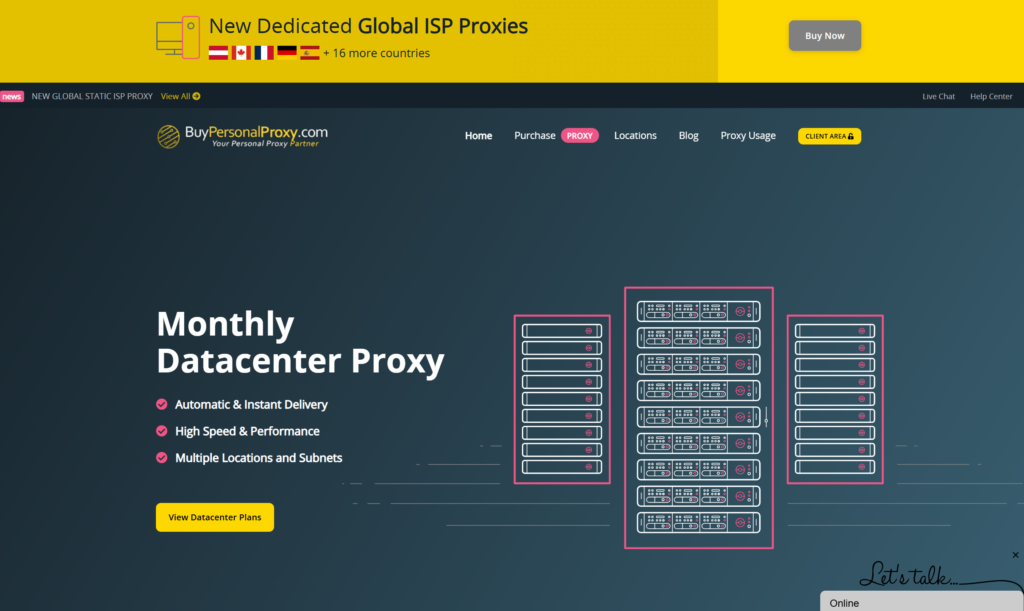
BuyPersonalProxy is a solid cheap datacenter pick for users who want low starting costs and a simple month-to-month plan. Its site advertises monthly or daily datacenter proxies starting at $1.29 per proxy per month, with automatic monthly billing and fast account delivery after payment confirmation. That makes it useful for smaller automation projects that need dedicated IPv4 proxies without a large upfront commitment.
Key features: monthly and daily datacenter proxies, dedicated IPv4 options, month-to-month billing, quick account setup. Accurate datthe site says pricing starts at $1.29 per proxy per month for the 1,000 proxy plan, and proxies appear in the account within about 5 minutes after payment is confirmed. Pros: Cheap starting rate, simple billing model, useful for focused projects on a budget. Cons: The lowest headline price is tied to larger-volume plans, so small buyers may pay more per IP.
18. PrivateProxy.me
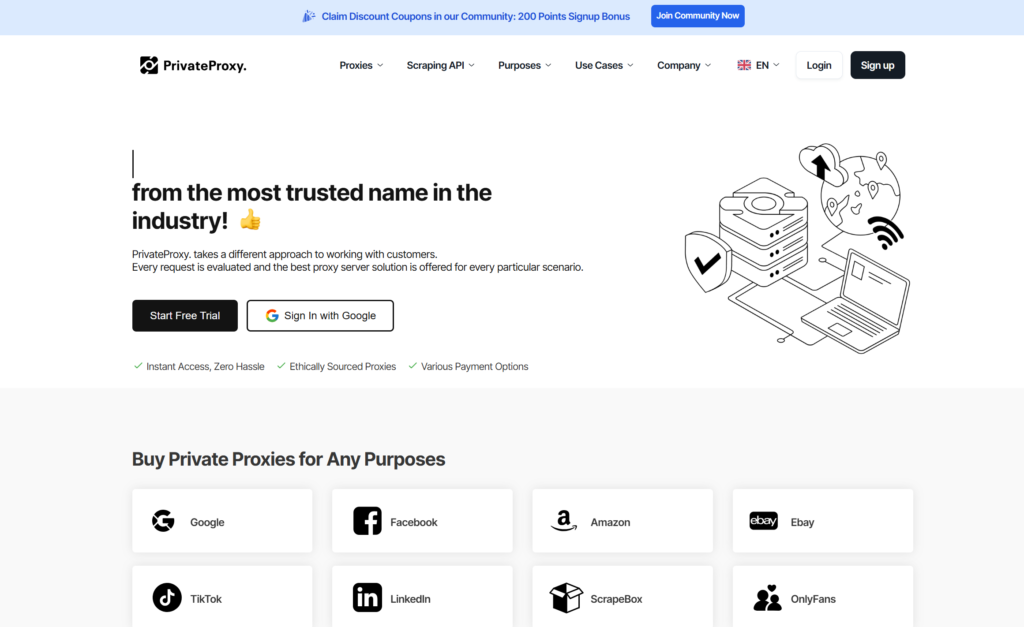
PrivateProxy.me is another low-cost datacenter option for users who want static private proxies with clear monthly pricing. Its site says datacenter static proxies start from $3 per month and are built for fast locations with round-the-clock technical support. The provider also positions its service around data scraping, research, and bot use cases, which fits the kind of workloads readers usually have in mind for cheap datacenter proxies.
Key features: static datacenter proxies, fast locations, technical support, support for scraping and research use cases. Accurate datPrivateProxy.me lists datacenter static proxies from $3 per month. Pros: Clear entry pricing, straightforward datacenter offer, relevant use-case positioning. Cons: The public pricing page gives fewer technical details about bandwidth, rotation, or API access than some larger competitors.
19. FineProxy
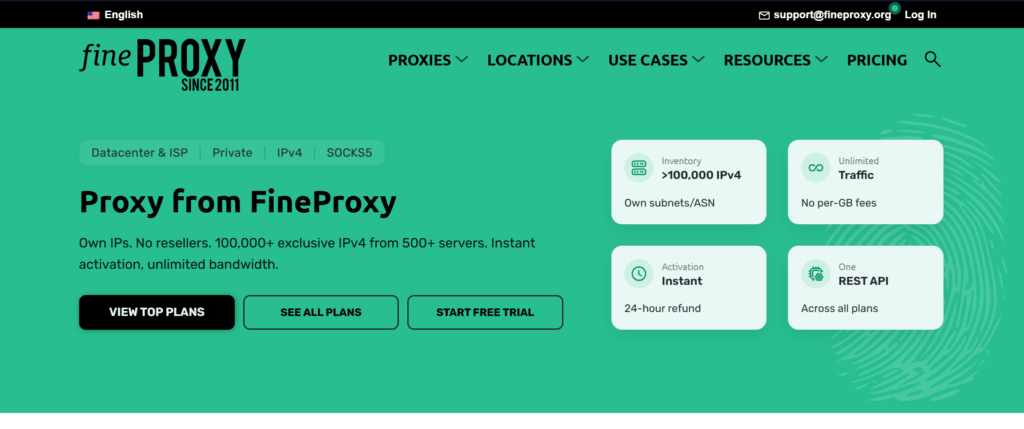
FineProxy is another budget-friendly datacenter option for users who want static IPs, unlimited bandwidth, and a free trial before scaling. Its datacenter page highlights lightning-fast speeds, advanced rotation, and server access that can handle one task or 10,000. That makes it a practical choice for scraping and automation users who want a simple datacenter-first offer rather than a broader residential platform.
Key features: static datacenter IPs, unlimited bandwidth, free trial, rotation tools, commercial and personal use coverage. Accurate datFineProxy says its datacenter proxies include unlimited bandwidth and that its servers can handle workloads from one task to 10,000. Pros: Free trial, unlimited bandwidth, straightforward datacenter positioning. Cons: The page gives fewer public details about location counts and pricing tiers than some competitors
How to choose the cheapest pricing model for your workload
If you run long sessions on the same targets, per-IP pricing is usually easier to control because you know exactly what each address is costing before the month starts. That makes it natural to point readers to what are dedicated proxies and ad-free proxies vs dedicated proxies when they are weighing predictable monthly costs against flexibility.
If your traffic comes in bursts, rotating datacenter plans billed by traffic can be more efficient because you are paying for usage instead of idle IP inventory. That fits well with what are data center rotating proxies and what are rotating proxies for readers who want a cleaner explanation before picking a plan.
Shared plans sit at the cheapest end of the market, but they make more sense on lenient targets than on sites where IP reputation matters a lot. This section can naturally link to what are shared proxies and cloud proxies vs shared proxies because both help explain where low-cost shared infrastructure fits best.
When to upgrade from cheap datacenter proxies
If success rates keep dropping, captchas spike, or geo-results look inconsistent, the problem may be the proxy type rather than the provider. At that point, readers may need what are residential proxies, what are ISP proxies, or mobile proxies vs residential proxies depending on whether they need stronger trust, longer sessions, or more app-like traffic.
Cheap datacenter proxies still work well for speed-first tasks like scraping, SERP collection, and large public-page checks. That is why residential mobile proxies for web scraping, residential mobile proxies for SERP data analysis, and residential mobile proxies for price monitoring fit naturally here as follow-up reading for buyers deciding whether to stay with datacenter or move up.
A simple rule helps: keep datacenter proxies for speed and volume, and upgrade only when block rates or session stability start damaging the workflow.
Shared vs Dedicated vs Rotating Datacenter Proxies: Which Is Cheapest?
Shared proxies win the pure price competition, often costing just $0.30-$1 per IP. Multiple users access the same addresses, which splits infrastructure costs but increases the chance someone else will get the IP flagged or banned. They work fine for low-stakes tasks like basic scraping on lenient sites.
Dedicated proxies give you exclusive access to each IP, typically ranging from $1.39-$3 per address. You control how the IP gets used, which reduces block rates and gives you more consistent performance. This middle-ground option suits most scraping and automation projects where reliability matters more than rock-bottom pricing.
Rotating proxies usually charge per gigabyte ($0.40-$1/GB) rather than per IP. The system automatically switches addresses for each request or session, which is ideal for large-scale scraping where you need constant IP diversity. Cost-per-task tends to be lowest here if you’re making thousands of requests, since you’re not paying for idle IPs.
Calculate your expected monthly requests and divide by the pricing model to find your cheapest option. A project making 100,000 daily requests might spend less on rotating proxies, while someone running 5 social media accounts would save money with dedicated IPs. For more guidance, check out our comparison of rotating vs static proxies.
Common Mistakes When Buying Cheap Datacenter Proxies (And How to Avoid Them)
Ignoring Success Rates
The cheapest proxy isn’t a bargain if half your requests fail. Look for providers publishing success rates above 95% or offering trials so you can test performance on your actual targets before committing.
Skipping Location Testing
A provider might offer 100+ countries but only maintain quality IPs in 10 of them. Test proxies in your target locations during trial periods to verify they work where you need them. ResiProx offers proxies in over 180 countries to ensure global coverage.
Not Calculating Total Cost
Compare apples to apples, convert per-IP and per-GB pricing into cost-per-task for your specific use case. Factor in bandwidth limits, overage charges, and whether you’ll actually use all the IPs you’re paying for.
Overlooking Rotation Settings
Some “rotating” proxies switch IPs every request, while others rotate hourly or daily. Mismatched rotation frequency can break session-based scraping or waste IPs on single-request tasks. Confirm rotation settings match your workflow.
Choosing Providers Without Refunds or Trials
Budget providers should still offer money-back guarantees or trial periods. Avoid services that lock you into monthly contracts without testing first, you might end up paying for proxies that don’t work for your needs.
Mixing Residential Use Cases with Datacenter Proxies
Datacenter IPs can’t access streaming services, pass residential verification checks, or handle social media accounts that flag server addresses. Don’t force datacenter proxies into use cases that require residential authenticity; you’ll waste money on blocks and bans.
Best Use Cases for Budget Datacenter Proxies in 2026
E-commerce price monitoring benefits from datacenter proxies’ speed and cost efficiency. You can scrape competitor prices across thousands of products daily without residential-level expenses. The sites you’re monitoring rarely block datacenter IPs since they want their prices visible.
SEO rank tracking and SERP scraping work perfectly with cheap datacenter proxies. Search engines serve results to datacenter IPs just fine, and you need to make lots of quick queries across different locations. Start testing affordable proxies for SEO to improve your ranking monitoring workflows.
Social media automation at moderate scale runs well on budget datacenter IPs. Managing a few accounts for posting, following, or data collection doesn’t trigger the same scrutiny as massive bot farms. Just rotate IPs regularly and keep activity patterns natural.
Competitor analysis and market intelligence gathering is where datacenter proxies shine. You’re typically scraping public business data, product catalogs, pricing pages, and company websites, none of which deploy aggressive anti-bot measures. Speed matters more than IP reputation for these tasks.
Local business data collection for directories, maps, and review sites works efficiently with datacenter proxies. These platforms serve data to anyone who requests it, and you can collect massive datasets quickly at a fraction of residential proxy costs.
FAQ
What are the best cheap datacenter proxies in 2026?
The best cheap datacenter proxies in 2026 include ResiProx for high-speed rotating proxies under $0.3s latency, Webshare for ultra-budget entry at $0.03/IP, and Proxy-Cheap for the lowest per-IP pricing around $0.30. ResiProx balances affordability with 99.9% uptime and 180+ country coverage, making it ideal for teams that need reliable performance without premium pricing. For specific use cases, consider dedicated options from IPRoyal or rotating proxies from DataImpulse.
Are cheap datacenter proxies reliable for web scraping?
Yes, cheap datacenter proxies are reliable for most web scraping tasks, especially when targeting sites without aggressive anti-bot systems. They deliver faster speeds than residential proxies and handle high-volume requests efficiently. Success depends on choosing providers with strong uptime guarantees (99%+), regular IP refreshes, and large enough pools to rotate addresses. For sites with strict detection, you may need residential proxies instead, but datacenter IPs work well for e-commerce, SEO tools, and market research.
How do datacenter proxies compare to residential proxies in cost?
Datacenter proxies cost 10-20x less than residential proxies on average. Budget datacenter IPs start at $0.30-$1 per IP or $0.40-$1 per GB, while residential proxies typically run $5-$15 per GB. The price difference comes from infrastructure, datacenter IPs are server-based, while residential proxies route through real user devices. For high-volume scraping where you don’t need residential authenticity, datacenter proxies offer better ROI. Mix both types strategically: use datacenter for bulk tasks and residential for sites that block server IPs.
Can I use cheap datacenter proxies for social media management?
You can use cheap datacenter proxies for moderate social media automation, but with limitations. Platforms like Instagram and Facebook actively flag and block datacenter IPs, so they work best for light automation, scheduling posts, basic data collection, or managing just a few accounts. For serious social media operations with multiple accounts, ISP proxies or residential proxies provide better success rates. Rotate IPs frequently and maintain natural activity patterns to reduce detection risk when using datacenter proxies.
Cheap datacenter proxies give you the speed and volume you need without the premium price tag. Whether you’re scraping thousands of product pages daily, monitoring competitor pricing, or running SEO tools across multiple locations, the right provider balances cost with performance. Test a few options from this list, most offer trials or money-back guarantees, and measure success rates on your actual targets before committing. Get started with fast, affordable datacenter proxies and see how much you can accomplish without breaking your budget.
Should I pay per IP or per GB for cheap datacenter proxies?
Per-IP pricing usually makes more sense when you need stable dedicated addresses for repeat tasks or longer sessions. Per-GB pricing is often better when your traffic is bursty and you want rotating infrastructure without paying for idle IPs.
Are shared datacenter proxies enough for SEO tools?
Yes, shared datacenter proxies can work well for many SEO workflows, especially rank checks and public SERP collection on less sensitive targets. If the tool starts seeing blocks or unstable results, moving to dedicated or rotating datacenter options is usually the next step.
How many datacenter proxies do I need for price monitoring?
That depends on request volume, target sensitivity, and how often you refresh product pages. Smaller catalogs can work with a limited pool, while large-scale monitoring usually benefits from rotation and better spread across subnets.
When do cheap datacenter proxies need SOCKS5 support?
SOCKS5 support matters more when your tools, scripts, or automation stack work better with flexible transport options than with basic HTTP-only setups. That is why what SOCKS5 proxies are and the best SOCKS5 proxy service providers are useful supporting links in this topic cluster.
What is the biggest warning sign that a budget datacenter provider is too cheap?
The biggest warning sign is not low price by itself but weak real-world stability, such as frequent captchas, repeated failed requests, or inconsistent geo-results. If that starts happening early in testing, the cheaper headline rate can end up costing more in lost data quality and wasted time.