
Mobile proxies in 2026 have become indispensable tools for businesses and individuals alike. These proxies use IP addresses from mobile carriers, providing a high level of anonymity and authenticity. They are particularly useful for tasks such as web scraping, market research, and social media management, where bypassing geo-restrictions and avoiding IP blocks are essential.
Proxy providers vary in network coverage, pricing, and carrier availability, making performance dependent on the underlying infrastructure. Comparisons of cheap mobile proxies often focus on balancing affordability with connection quality, while reviews of the best mobile proxy services evaluate factors such as IP pool size, uptime, and rotation options. Region-specific solutions like the best Australia proxies support localized browsing and data collection, and mobile residential proxies combine carrier-assigned IP addresses with residential-grade authenticity for demanding automation and research workloads.
Discover Our Best:
- What Are Mobile Proxies?
- Benefits of Mobile Proxies
- Mobile Proxies vs. Residential Proxies
- Use Cases for Mobile Proxies
- Safety and Ethical Use of Mobile Proxies
- Why Use Mobile Proxies?
- Choosing the Best Mobile Proxy Provider
- Top Mobile Proxy Providers for 2026
- Sticky Sessions vs Rotating Mobile Proxies: Which Should You Choose?
- 4G/LTE vs 5G Mobile Proxies: Key Differences and When to Use Each
- Latest News In 2026
- FAQ
What Are Mobile Proxies?
3G/4G/5G/6G/LTE Mobile proxies are servers that use IP addresses from mobile internet service providers. They direct web traffic through a mobile device connected to a cellular network, providing anonymity and making it appear as if the user is browsing from a mobile device. This feature is especially beneficial for tasks requiring high authenticity and low block rates.
Benefits of Mobile Proxies
Mobile proxies offer several key benefits:
- Enhanced Security: They protect against malicious websites by routing traffic through a mobile device, reducing the risk of infecting your device with malware.
- Geo-Targeting: Mobile proxies provide precise geo-targeting, as IP addresses are assigned based on the device’s location.
- Speed and Reliability: They offer fast internet speeds, particularly with 5G proxies, making them reliable for high-speed data scraping and automation.
How Mobile Proxies Work
Mobile proxies work by routing your internet requests through a mobile device connected to a cellular network. This process involves using IP addresses assigned by mobile carriers, which can change frequently as the device moves between different cell towers. This dynamic nature helps in evading detection algorithms and maintaining anonymity.
Mobile Proxies vs. Residential Proxies
Both mobile proxies and residential proxies are used for maintaining anonymity and bypassing restrictions. However, they have distinct differences:
| Feature | Mobile Proxies | Residential Proxies |
| IP Source | Mobile ISPs | Residential ISPs |
| Connection Type | Cellular Network | Wired Connection |
| Speed | Fast, especially with 5G | Stable but generally slower |
| Geo-Targeting | Precise, based on device location | Broader geographical coverage |
| Use Cases | Ad verification, social media automation | General web scraping, ad monitoring |
Advantages of Mobile Proxies
- High Legitimacy: Mobile proxies are less likely to be blocked because they mimic real mobile users.
- Flexibility: They can be used for various tasks requiring mobile-specific data access.
Use Cases for Mobile Proxies
Mobile proxies are particularly useful in scenarios where mimicking mobile user behavior is essential:
- Ad Verification: Ensuring ads are displayed correctly on mobile platforms.
- Social Media Automation: Managing social media accounts from a mobile perspective.
- Price Comparison: Getting accurate prices by hiding location and carrier information.
- Web Scraping: Collecting data from mobile-targeted platforms.
Discover Our:
Safety and Ethical Use of Mobile Proxies
To use mobile proxies safely and ethically:
- Choose a Reputable Provider: Ensure the provider offers ethically sourced mobile proxies.
- Use Responsibly: Avoid activities that could lead to IP flagging or blocking.
Why Use Mobile Proxies?
- Anonymity and Security: Mobile proxies offer a secure way to browse the internet, masking your real IP address and protecting your identity.
- Geo-Location Targeting: They allow you to access content restricted by location, making them ideal for market research and data collection.
- Anti-Detection: Mobile proxies are harder to detect than other types of proxies, reducing the risk of being blocked by websites.
Choosing the Best Mobile Proxy Provider
When selecting a mobile proxy provider, several factors should be considered:
- IP Pool Size and Location Coverage: A larger pool with extensive global coverage ensures better performance and flexibility.
- Pricing and Plans: Look for providers offering flexible pricing models that fit your budget and needs.
- Customer Support: Reliable support is crucial for resolving any issues promptly.
- Features and Customization: Consider providers offering advanced features like geo-targeting and customizable plans.
Top Mobile Proxy Providers for 2026
1) 🏆 ResiProx 🏆
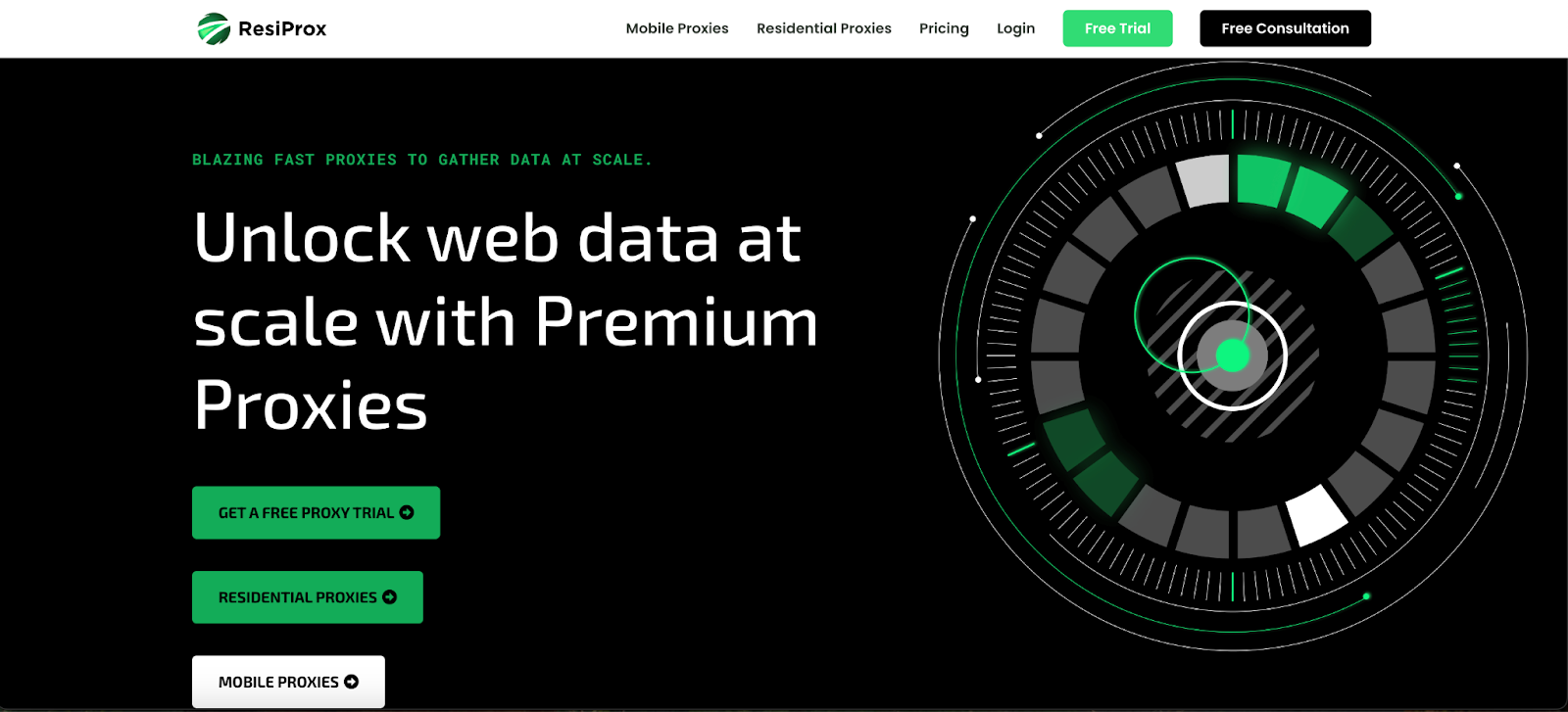
Resiprox Premium Proxies – Unlock the Web with Power and Precision
Introducing Resiprox, the ultimate proxy solution designed to supercharge your online operations. With our Residential Proxies and Mobile Proxies, you get unmatched access to web data at scale, robust security, and seamless connectivity all backed by a free trial to experience the difference firsthand.
Product Features
- Rotating Residential Proxies: Harness the power of 10M+ ethically-sourced IPs across 180+ countries. These proxies rotate dynamically to support large-scale public data collection, market research, and workflows that benefit from automatic IP rotation, delivering 99.9% uptime and precise targeting at the country, city, or ZIP code level.
- Rotating Mobile Proxies: Powered by 4G/LTE/5G networks, our mobile proxies offer lightning-fast speeds with <0.3s response times and a 99.9% success rate perfect for real-time applications.
- Global IP Network: Tap into millions of IPs, including 3.5M+ in the US, 1.8M+ in Brazil, 3.1M+ in India, and more, ensuring coverage wherever you need it.
- Advanced Capabilities: Enjoy HTTPS & SOCKS5 support, unlimited concurrent sessions, and flexible rotating or sticky sessions, all wrapped in premium IP quality.
Product Specifications:
- Performance: High-speed browsing with 99.9% uptime and 24/7 expert support.
- Integration: Seamlessly works with Node.js, Python, PHP, Selenium, and more, featuring a dynamic endpoint generator and robust API access.
What It’s Built For:
Resiprox proxies are your all-in-one tool for:
- Public Data Collection: Collect public web data for approved business use cases, market research, and growth insights.
- Price Monitoring: Track prices across regions in real-time.
- Multi-Account Workflows: Run separate QA, monitoring, and research workflows across multiple accounts.
- SEO & Ad Verification: Monitor rankings and verify ads globally.
- Cybersecurity: Protect your brand and test applications securely.
- Specialized Tasks: From high-volume monitoring of limited-release products to travel fare aggregation, Resiprox delivers.
Why Resiprox Stands Out:
This isn’t just a proxy, it’s a game-changer. With comprehensive documentation, multi-platform compatibility, and a team of experts available 24/7, Resiprox ensures your projects run smoothly. Whether you’re a business scaling operations, a researcher gathering data, or a developer testing apps, our proxies adapt to your needs with precision and reliability.
Resiprox Premium Proxies – Your Key to a Smarter, Faster, and More Connected Online World.
Click here to discover our :
2. ProxyEmpire
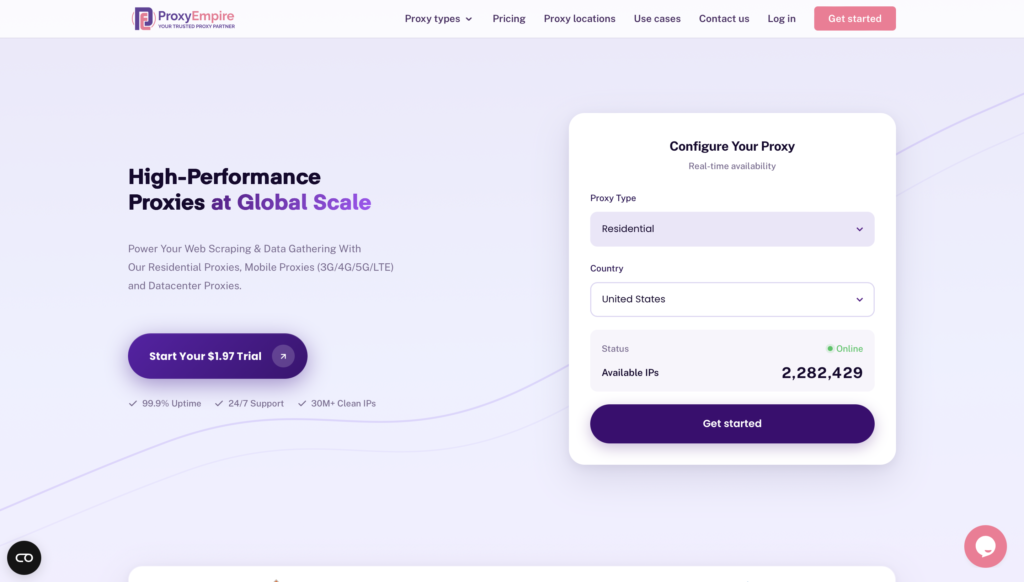
ProxyEmpire delivers a versatile mobile proxy network built around more than 4 million real cellular IPs spanning over 170 countries. Users can choose rotating shared pools billed by traffic or dedicated packages focused on specific carriers and regions, including extensive US 5G coverage across dozens of states. The platform supports country, city, carrier, and ASN targeting along with flexible sticky or per-request rotation, HTTP and SOCKS5 protocols, and unlimited concurrent sessions. A standout element is the data rollover feature that allows unused bandwidth to carry forward, reducing waste on variable workloads. Pricing starts competitively for pay-as-you-go mobile traffic and scales into dedicated monthly options suitable for sustained projects. The service integrates well with common automation tools and provides responsive support, making it practical for ad verification, price monitoring, market research, and location-based testing with mobile IPs. Overall it balances accessibility for smaller teams with enough depth for mid-scale public data collection and multi-account workflows that benefit from genuine carrier connections.
3. Smartproxy
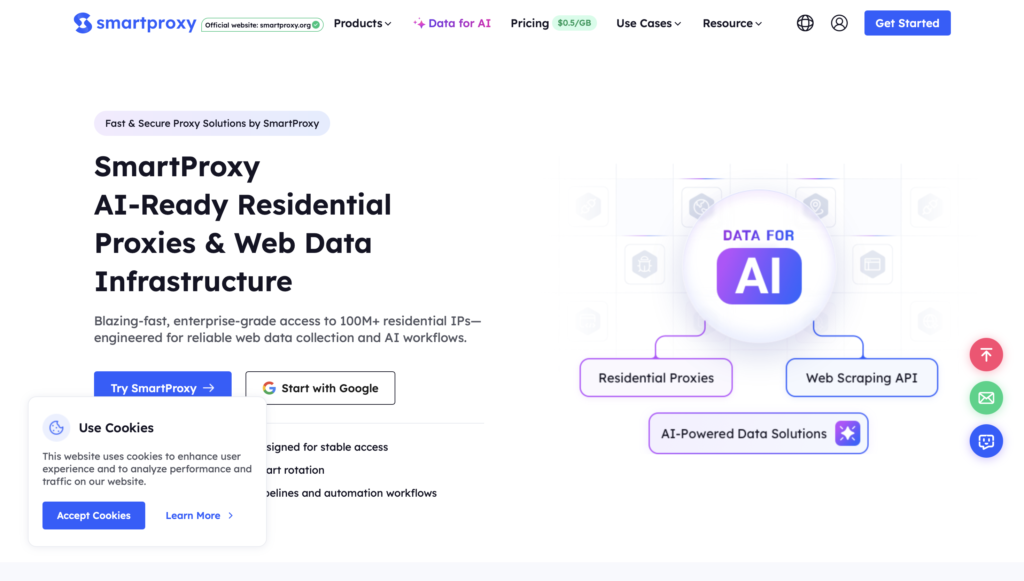
Smartproxy, now operating under the Decodo brand, maintains one of the larger ethically sourced mobile proxy pools with over 10 million IPs drawn from more than 700 carriers across 160-plus locations. The network emphasizes fast response times, high success rates near 99.75 percent, and support for both rotating and sticky sessions lasting up to 24 hours. Targeting options include country, city, and carrier selection, while protocols cover HTTP(S) and SOCKS5 with unlimited concurrent connections. Pricing is structured around bandwidth tiers that become more economical at higher volumes, often starting near the lower end of the market for mobile traffic and including promotional discounts. The dashboard and documentation are designed for straightforward setup, with integrations available for popular programming languages and scraping frameworks. This combination suits teams running ad verification, price monitoring, market research, and location-based testing that rely on authentic mobile network behavior. Smartproxy continues to appeal to startups and growing operations seeking reliable carrier-grade access without excessive complexity.
4. Oxylabs
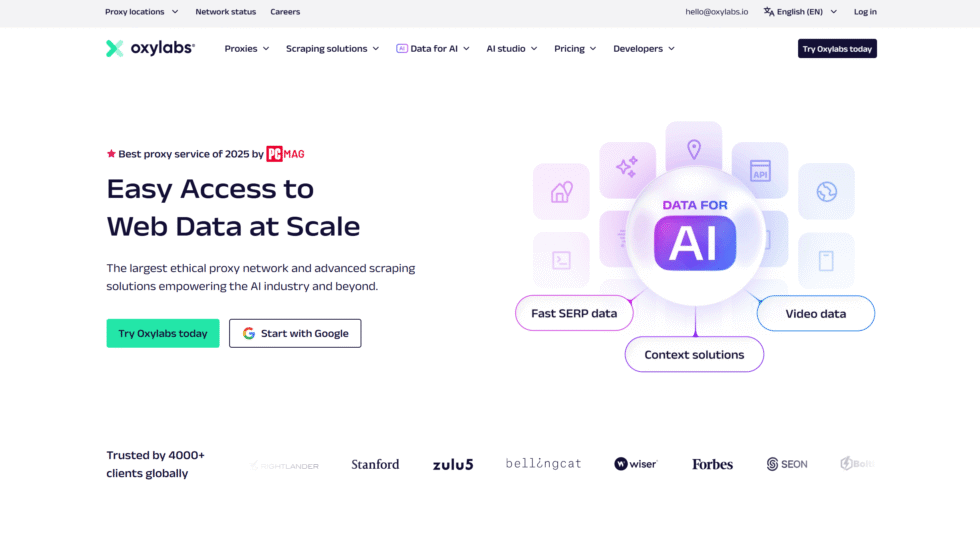
Oxylabs provides enterprise-oriented mobile proxies featuring real cellular IPs across more than 140 locations and automatic rotation capabilities. The network supports 3G, 4G, and 5G connections with geo-targeting down to country, city, state, coordinates, and ASN levels at no extra cost. Session control allows sticky IPs for extended periods, and the service integrates cleanly with public APIs, major programming languages, and third-party tools. Performance benchmarks frequently highlight strong infrastructure success rates and low response times, positioning the product for demanding public data collection. Pricing follows a bandwidth model with volume discounts that become attractive for larger commitments, though entry costs sit higher than many mid-market alternatives. Dedicated account management, detailed documentation, and 24/7 support further support complex deployments. Oxylabs is particularly well suited for ad verification, price monitoring, market research, and location-based testing where consistent mobile authenticity and scalable infrastructure matter most.
5. Bright Data
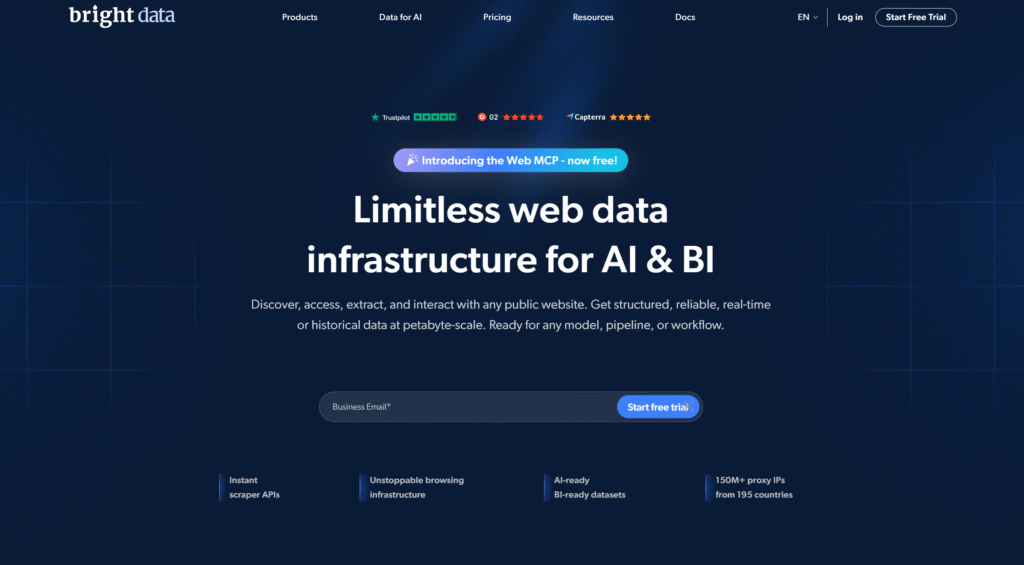
Bright Data historically offered one of the most extensive mobile proxy networks with millions of real 3G, 4G, and 5G IPs covering nearly every country and supporting carrier, ASN, and city-level targeting. The platform included advanced session controls, high uptime guarantees, and deep integration with complementary tools such as scraping browsers and data APIs. As of April 2026 the mobile proxy product is no longer available to new customers, though existing accounts with active zones may continue using it. For organizations already onboarded, the network still delivers high-trust cellular connections ideal for ad verification, price monitoring, market research, and location-based testing. New users seeking similar capabilities are directed toward the company’s residential or other proxy products. Bright Data remains recognized for its compliance certifications, extensive documentation, and enterprise-grade support infrastructure even as its mobile offering transitions.
6. NetNut
NetNut supplies mobile proxies drawn from a pool exceeding 5 million real 3G, 4G, 5G, and LTE addresses across more than 100 countries. The service focuses on stability, city and state targeting, and high reported success rates near 99.9 percent. Users access rotating or sticky sessions through a straightforward dashboard with API support and IP whitelisting options. Pricing is organized into monthly bandwidth packages rather than pure pay-as-you-go, with entry tiers providing several gigabytes and larger plans offering improved per-gigabyte rates. Support includes live chat and dedicated account managers for higher tiers. The network is frequently chosen for public data collection, ad verification, price monitoring, and market research that benefit from authentic mobile carrier IPs. While geographic coverage is solid rather than industry-leading, NetNut emphasizes reliable performance and responsive assistance for enterprise and mid-sized teams.
7. Infatica
Infatica operates a peer-to-peer mobile proxy network containing several million real-device IPs alongside its larger residential pool. The mobile offering supports rotating and sticky sessions, country-level targeting, and standard HTTP and SOCKS5 protocols. Pricing begins at higher per-gigabyte rates for pay-as-you-go traffic and improves with subscription volume commitments, including optional yearly discounts. A low-cost trial option allows testing on the live network before larger purchases. Performance can vary by region, with stronger results reported in major markets. The platform provides a functional dashboard, usage analytics, and responsive support that many users praise by name. Infatica works well for ad verification, price monitoring, market research, and location-based testing where ethically sourced mobile connections are preferred and budgets favor flexible rather than fully enterprise-scale packages.
8. IPRoyal
IPRoyal offers both dedicated and rotating mobile proxies sourced from genuine carrier networks. Dedicated options provide exclusive IPs with unlimited traffic and configurable rotation intervals, while the newer rotating product bills strictly by bandwidth for more variable demand. Targeting reaches country, state, and city levels in key markets, and protocols include HTTP(S) and SOCKS5. The service supports manual or automatic rotation and integrates with common automation and browser tools. Pricing for dedicated mobile proxies follows time-based plans with multi-day discounts, whereas rotating traffic follows volume tiers. Customer support is available through live chat and additional channels. IPRoyal is practical for teams needing consistent sessions for multi-account work or flexible bandwidth for ad verification, price monitoring, market research, and location-based testing that require authentic mobile footprints.
9. SOAX
SOAX maintains a large mobile proxy inventory claimed at over 30 million 3G, 4G, 5G, and LTE IPs across more than 195 locations. The network supports city-level and ISP targeting, sticky sessions up to 60 minutes, and both rotating and fixed options. Users can combine residential and mobile traffic, apply custom rotation rules based on time or errors, and choose DNS resolution preferences. Success rates are consistently reported near 99 percent with competitive response times. Pricing is segmented by location value tiers and scales with volume, accompanied by a low-cost short trial. The dashboard and documentation receive strong feedback for clarity and developer control. SOAX fits ad verification, price monitoring, market research, and location-based testing that benefit from granular carrier selection and flexible session management on real cellular networks.
10. HydraProxy
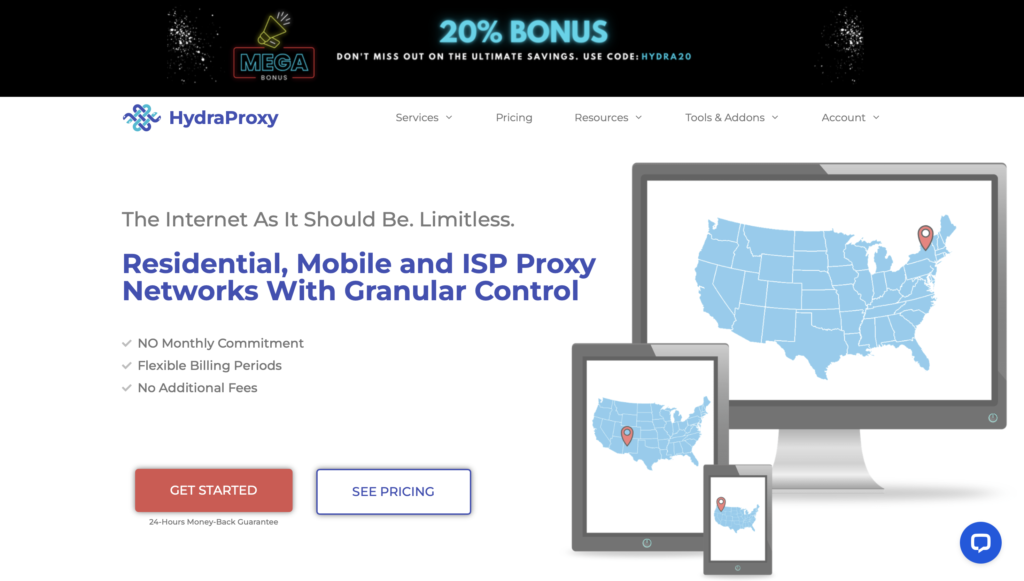
HydraProxy specializes in US-focused and international 4G and 5G mobile proxies available as static or rotating options with multi-carrier support. The pool includes hundreds of thousands of addresses across dozens of countries, with state and city geo-targeting plus ISP selection. Users enjoy unlimited bandwidth on many plans, flexible rotation intervals ranging from minutes to extended periods, and both HTTP and SOCKS protocols. Billing is short-term and non-recurring, allowing daily, multi-day, or monthly access without long commitments. Setup is straightforward with whitelisting and dashboard controls. The service is frequently selected for projects that need genuine mobile carrier IPs for ad verification, price monitoring, market research, and location-based testing, especially when US coverage and rapid on-demand rotation are priorities.
11. Rayobyte
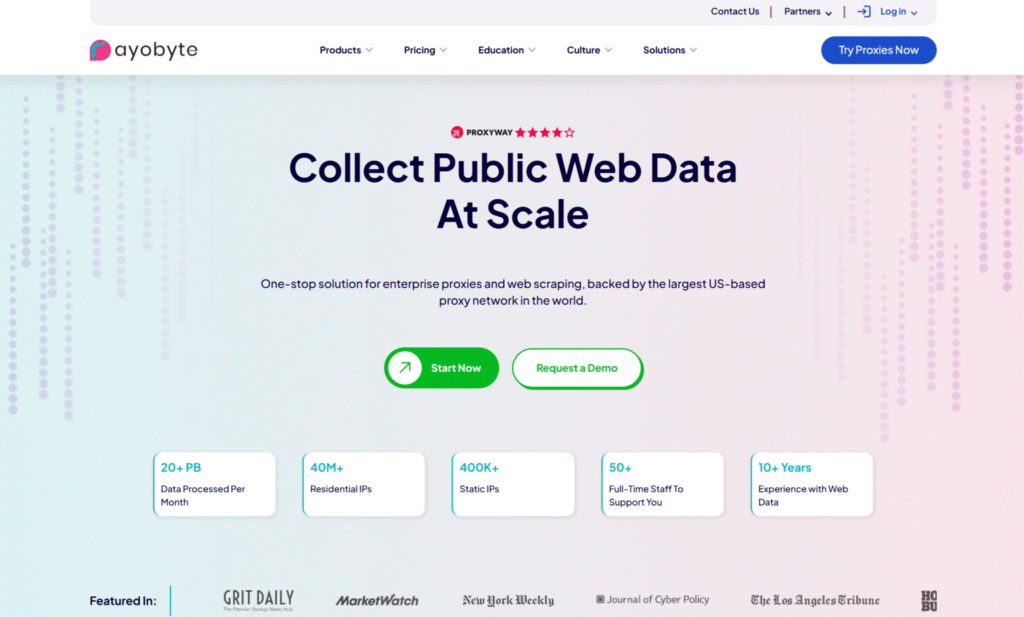
Rayobyte supplies rotating mobile proxies based on real 3G, 4G, and 5G cellular connections, with recent expansions into carrier-aligned infrastructure in key markets. The network supports sticky and rotating sessions, HTTP(S) and SOCKS5, and carrier-level targeting. Pricing has become notably competitive, with volume packages offering aggressive per-gigabyte rates that open higher-bandwidth use cases. Bandwidth is allocated monthly and can be supplemented as needed. The platform shares dashboard access with other Rayobyte products and provides API and integration support. Performance emphasizes clean carrier-native IPs suitable for public data collection. Rayobyte is appropriate for ad verification, price monitoring, market research, and location-based testing where cost-efficient mobile authenticity and scalable request volumes are required.
12. IPBurger
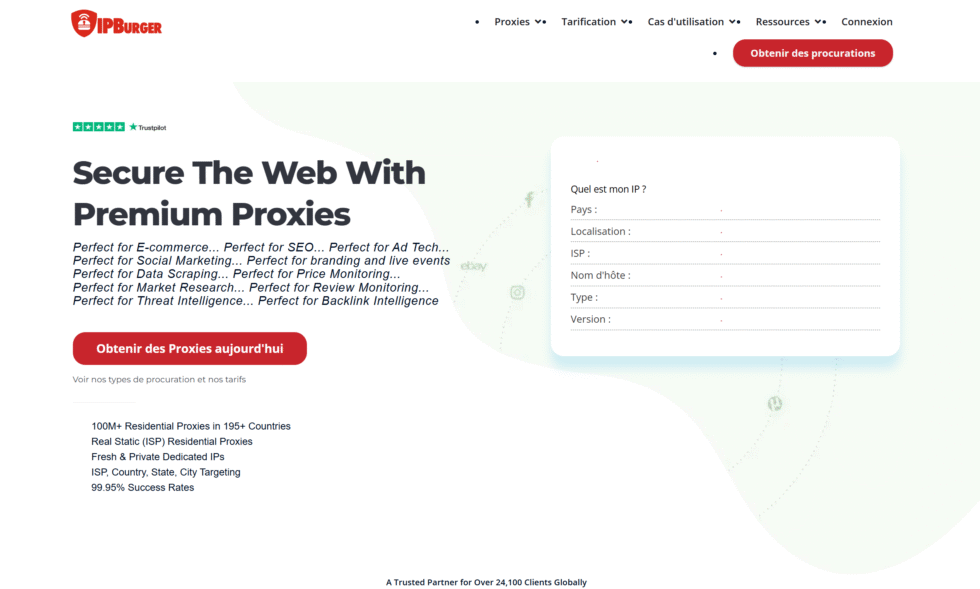
IPBurger provides access to more than 9 million real mobile device IPs across 100-plus countries, with support for 3G, 4G, and 5G networks. Features include ISP and ASN filtering, sticky sessions lasting up to 30 minutes, unlimited concurrent connections, and HTTP plus SOCKS5 protocols. The dashboard enables quick configuration and smart routing that automatically manages slower connections. Pricing follows bandwidth tiers with options for multiple sub-users and custom enterprise packages. Uptime is reported near 99.9 percent, backed by 24/7 support. The service is designed for straightforward adoption by teams conducting ad verification, price monitoring, market research, and location-based testing that rely on authentic smartphone-level connections without complex setup requirements.
13. Proxys.io
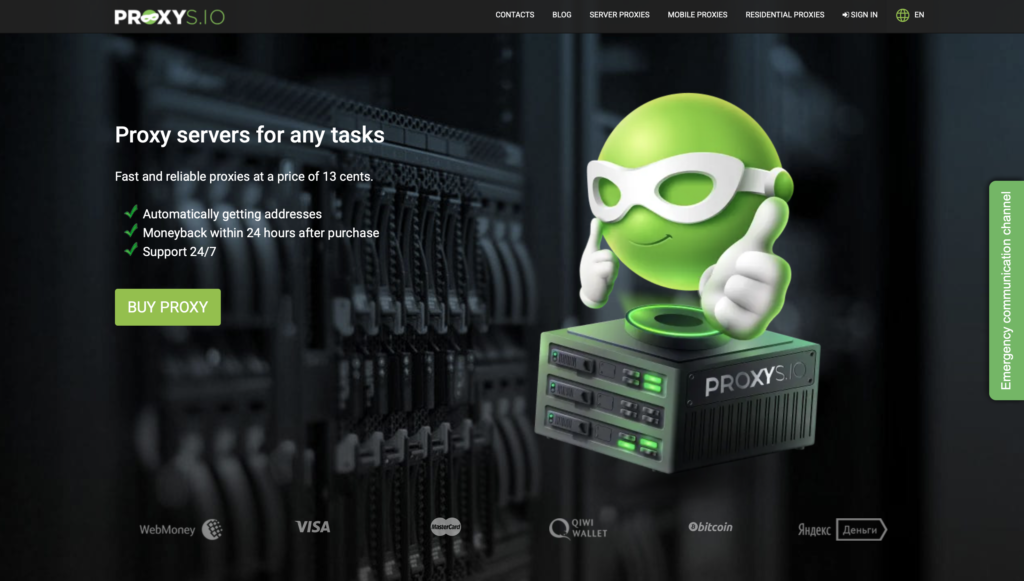
Proxys.io offers real 4G, LTE, and 5G mobile proxies with options for individual dedicated or shared access across roughly 20 countries. Users can select city and carrier targeting where available, choose rotation intervals from minutes to longer periods, and enjoy unlimited bandwidth on many plans. Protocols and authentication methods are flexible, and the service includes both fixed-location and geo-changeable variants. Pricing is typically monthly or shorter-term per proxy rather than pure bandwidth, making costs predictable for ongoing use. Support is highlighted for fast human responses around the clock. The broader catalogue also covers datacenter and residential options, allowing mixed deployments. Proxys.io serves teams focused on ad verification, price monitoring, market research, and location-based testing that prefer genuine mobile carrier IPs with clear, usage-based billing and reliable session control.
14. Proxidize
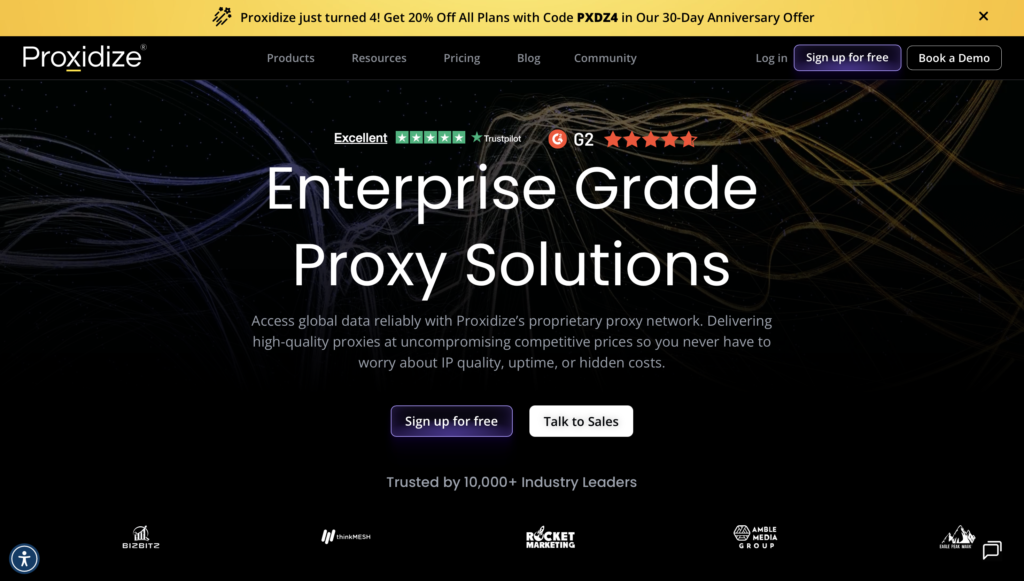
Proxidize operates a managed network of real U.S. 4G and 5G carrier IPs drawn from premium mobile operators across more than 50 locations nationwide. The service focuses exclusively on United States coverage with city-level targeting and carrier selection options that can be adjusted at any time. Users choose between dedicated per-proxy assignments offering full rotation control or shared access points that draw from a common mobile pool. Protocols include HTTP and SOCKS5 with UDP support over SOCKS5. Sticky sessions typically hold for one to four hours under carrier conditions while random rotation is also available. The platform provides near continuous uptime through automatic failover and browser-based management tools. Proxidize suits teams running ad verification, price monitoring, market research, and location-based testing that require authentic U.S. mobile network behavior for public web experiences across supported cities.
- Key features: Real 4G/5G SIM-based carrier IPs, city-level and carrier targeting, sticky or random rotation, HTTP and SOCKS5 protocols with UDP support, instant activation, automatic failover under 30 seconds.
- Accurate data: Coverage limited to the United States with infrastructure in 50-plus cities, sticky sessions lasting approximately 1–4 hours, high reported uptime near 100 percent on managed hardware.
15. CyberYozh
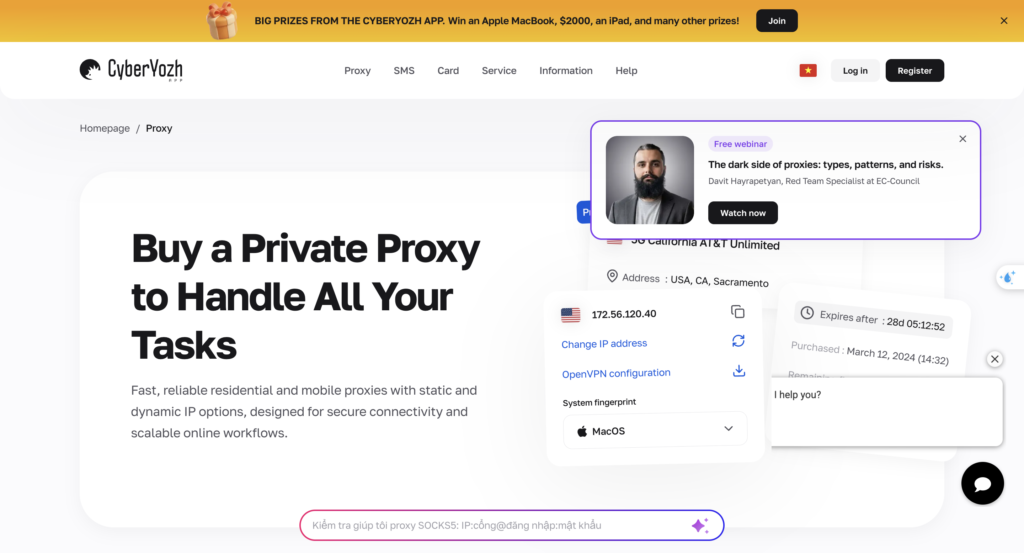
CyberYozh supplies dedicated and shared 5G and 4G mobile proxies concentrated on multiple U.S. states including California, Texas, Florida, New York, Massachusetts, Colorado, and Georgia. The network uses real carrier connections from operators such as T-Mobile, Verizon, and AT&T with options for city-level precision in many locations. Dedicated setups run on private 5G routers supporting manual IP changes, p0f fingerprint switching across Windows, macOS, and Android, and protocols that include SOCKS5, HTTP, VPN, and VLESS/Xray. Shared options allow limited concurrent users per port with timed rotation. High trust rates and low latency are emphasized through carrier-native network parameters. The service supports workflows that need consistent mobile identity for ad verification, price monitoring, market research, and location-based testing with genuine U.S. cellular connections.
- Key features: Dedicated 5G routers and shared options, p0f OS fingerprint control, manual or timed IP rotation, SOCKS5 with UDP, HTTP, VPN, and VLESS/Xray protocols, city and state targeting across multiple U.S. regions.
- Accurate data: Coverage spans major U.S. states with T-Mobile, Verizon, and AT&T carriers, high reported trust rates matching provider network parameters, support for both unlimited dedicated and multi-user shared configurations.
16. VoidMob
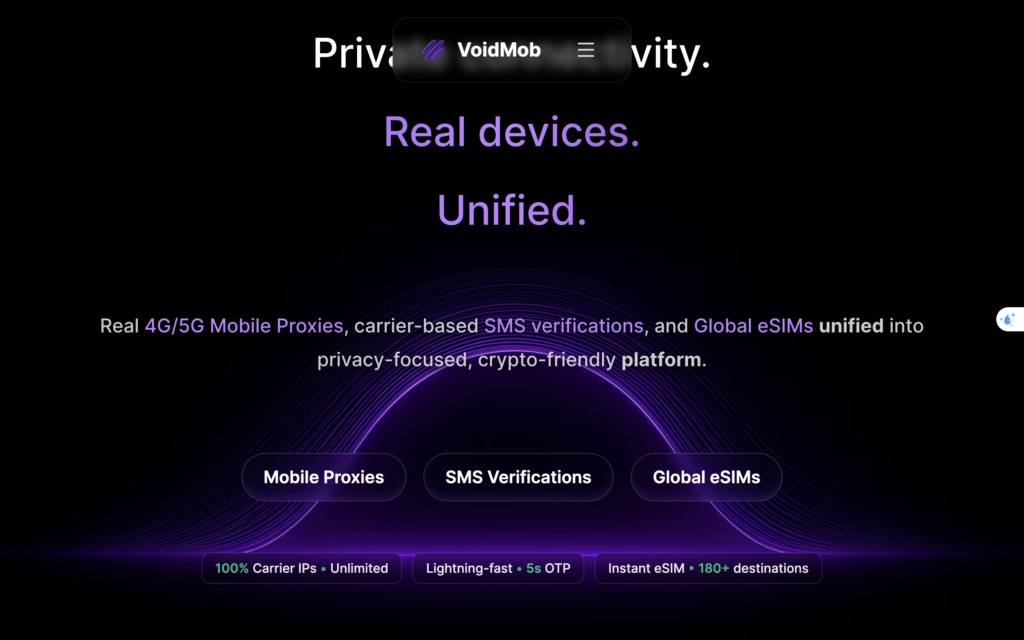
VoidMob delivers mobile proxies through both shared traffic-based pools and dedicated physical modems or routers using real carrier connections. Shared plans provide global coverage with country, region, and city targeting while dedicated options focus on exclusive hardware assignments with unlimited bandwidth. Protocols cover HTTP and SOCKS5 across all tiers, with premium dedicated units adding VLESS/Xray, OpenVPN, dedicated DNS, and p0f fingerprint switching. Rotation includes per-request, sticky, timed, and on-demand methods. Real-time modem health monitoring and connection testing tools are available in the dashboard. The provider emphasizes ethical sourcing through certified SDK networks for shared traffic and in-house hardware for dedicated units. VoidMob supports ad verification, price monitoring, market research, and location-based testing that benefit from authentic mobile carrier IPs and flexible session control.
- Key features: Shared global pool and dedicated modem/router hardware, HTTP/SOCKS5 plus VLESS/Xray and OpenVPN on premium tiers, p0f fingerprint switching, on-demand or timed rotation, real-time health monitoring, proxy lists with independent targeting.
- Accurate data: Shared pool exceeds 11 million mobile IPs with country and carrier targeting, dedicated units use physical SIM hardware, support for up to 100 separate endpoints per shared order.
17. USProxy.club
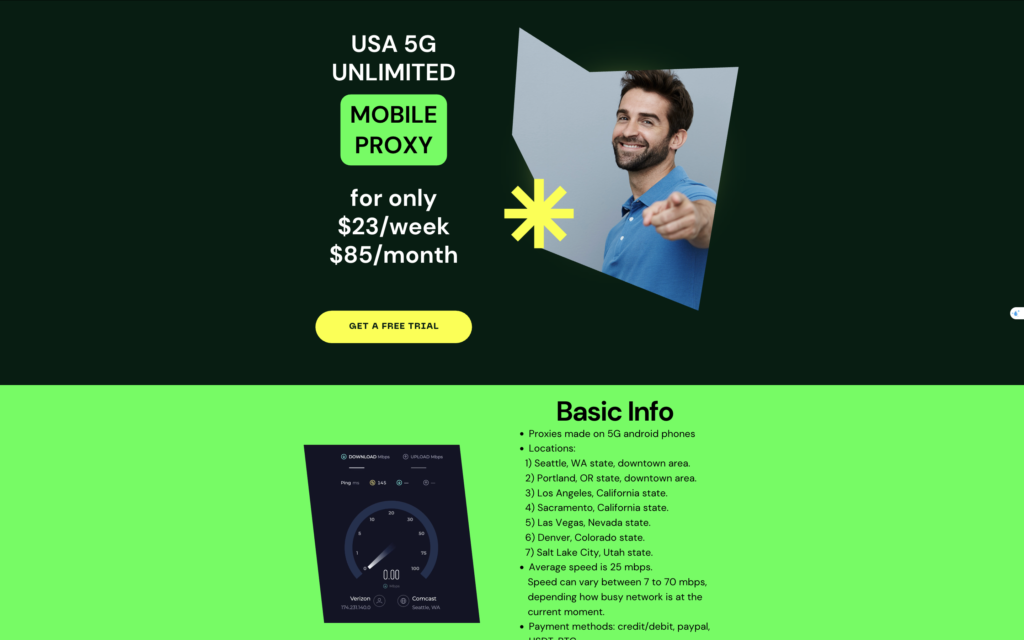
USProxy.club specializes exclusively in United States 5G mobile proxies sourced from major carriers including AT&T, Verizon, and T-Mobile. The boutique operation focuses on dedicated ports with standard dashboard controls, API access, and rotation methods suited to single-geography workflows. Users receive real carrier-grade connections that reflect genuine mobile network behavior across the domestic market. The service maintains a narrow but deep operational focus on U.S. coverage rather than multi-country expansion. Complimentary trial access is typically offered for evaluation. This concentrated approach supports teams that need reliable U.S. mobile IPs for ad verification, price monitoring, market research, and location-based testing confined to American carrier networks and public web experiences within the United States.
- Key features: USA-only 5G dedicated ports, AT&T/Verizon/T-Mobile carrier mix, API and dashboard rotation controls, real carrier connections, complimentary trial availability.
- Accurate data: Single-country specialist model covering the full United States, transparent major-carrier sourcing, dedicated modem infrastructure with standard control panel features.
18. MobileHop
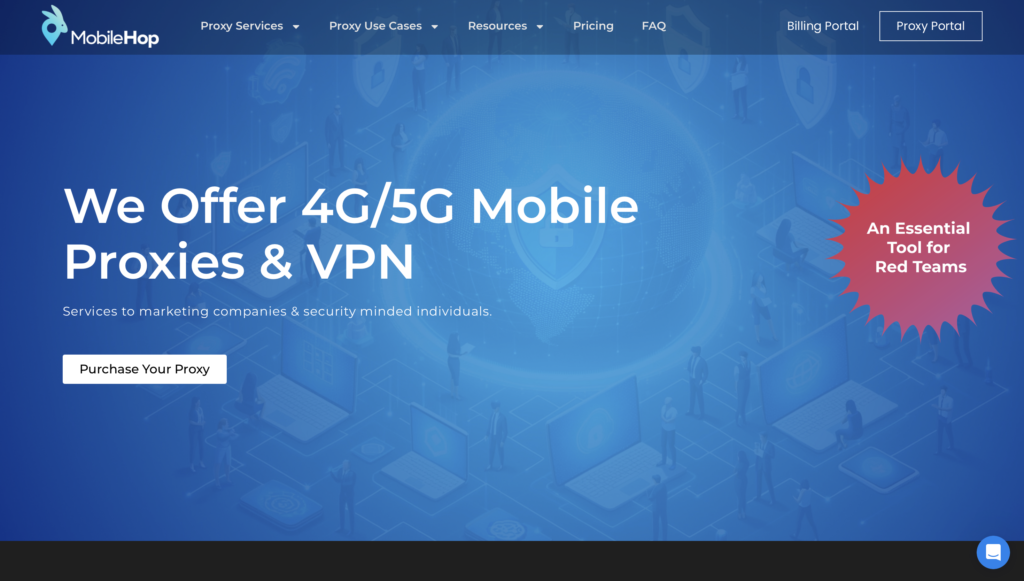
MobileHop provides United States 4G and 5G mobile proxies with support for unlimited bandwidth and location hopping across domestic regions. The service emphasizes high-speed cellular connections suitable for continuous operation and flexible geographic movement within the U.S. market. Protocols and authentication follow standard industry patterns for easy integration with common tools. Rotation capabilities allow users to shift locations as needed while maintaining mobile carrier authenticity. The platform is positioned for operators seeking straightforward U.S.-centric mobile access without extensive multi-country complexity. MobileHop is used for ad verification, price monitoring, market research, and location-based testing that rely on genuine American cellular IPs and the ability to change regional presence dynamically.
- Key features: U.S. 4G/5G carrier IPs, unlimited bandwidth support, location hopping across domestic regions, standard protocol compatibility, flexible rotation for geographic shifts.
- Accurate data: Focused exclusively on United States coverage with 4G and 5G options, designed for continuous high-bandwidth mobile sessions and multi-location workflows within the country.
19. Geonix
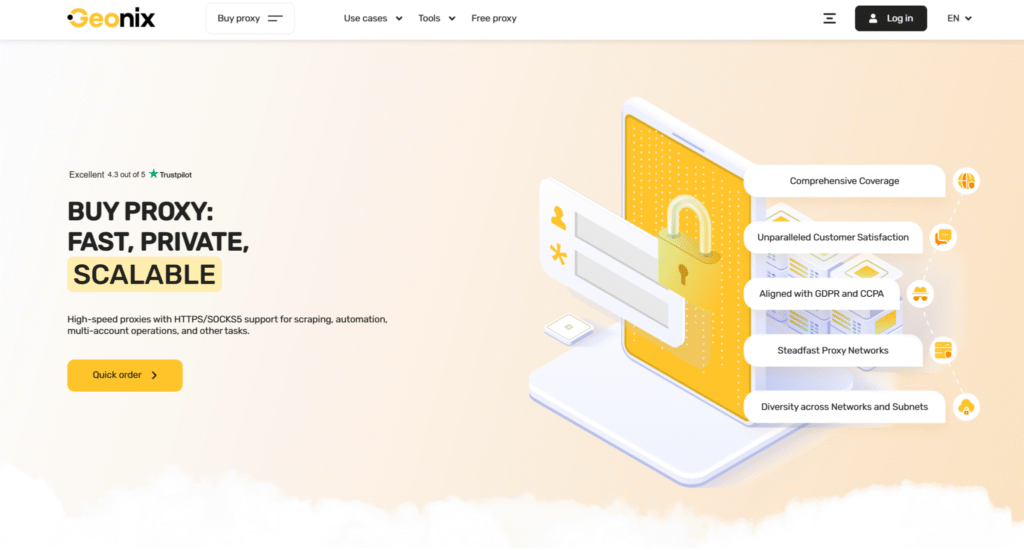
Geonix offers 4G and LTE mobile proxies with competitive coverage oriented toward multi-accounting, public data collection, and automation tasks. The network includes options suitable for social media related research and online activity monitoring. Users access rotating or dedicated configurations with HTTP and SOCKS5 support. Geographic reach includes United States locations among broader availability. The service maintains a mid-range positioning that balances accessibility with functional mobile authenticity. Geonix is applied in ad verification, price monitoring, market research, and location-based testing where real mobile carrier IPs help replicate genuine user experiences across supported regions.
- Key features: 4G/LTE mobile proxies, HTTP and SOCKS5 protocols, rotating and dedicated options, multi-purpose support for automation and research workflows, United States and additional location availability.
- Accurate data: Designed for multi-accounting and public data collection use cases, mid-tier market positioning with functional carrier-level mobile connections.
20. ProxyGuys
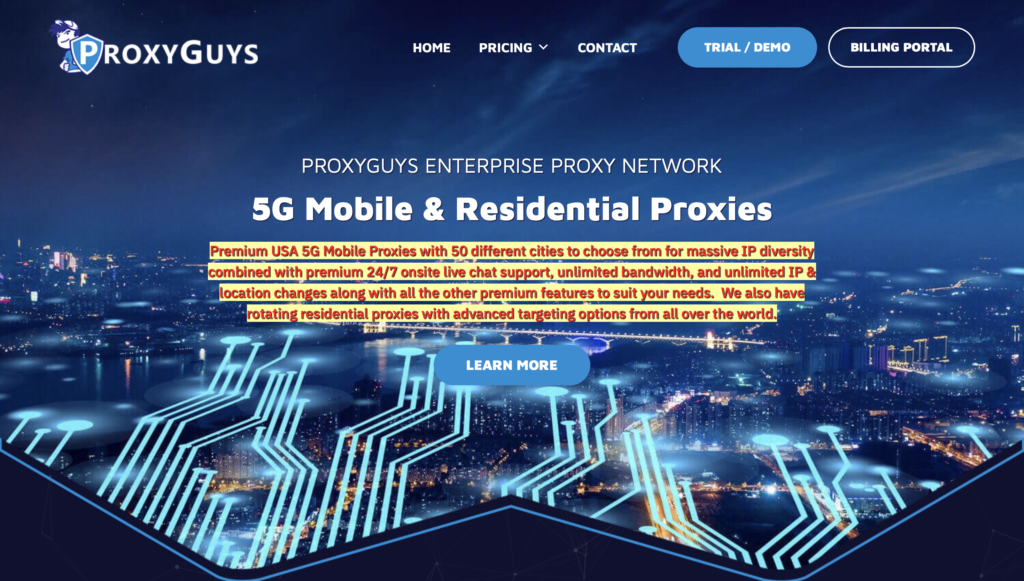
ProxyGuys specializes in high-speed United States mobile proxies featuring unlimited bandwidth allocations. The service delivers real cellular connections optimized for sustained performance within the domestic market. Standard protocol support enables straightforward integration into existing toolchains. Rotation and session management options accommodate both short and longer running tasks. The provider targets operators who prioritize U.S. mobile authenticity and consistent throughput for ongoing projects. ProxyGuys is employed for ad verification, price monitoring, market research, and location-based testing that depend on authentic American mobile network IPs and reliable high-speed cellular access.
- Key features: High-speed U.S. mobile proxies, unlimited bandwidth, real cellular carrier connections, standard protocol support, session and rotation management for sustained workflows.
- Accurate data: United States focused coverage with emphasis on continuous high-throughput mobile sessions and domestic carrier authenticity.
Sticky Sessions vs Rotating Mobile Proxies: Which Should You Choose?
Sticky proxy sessions keep the same mobile IP active for a set period. This matches real phone behavior where a device holds one address while a person finishes a login, form sequence, or multi-page review. Many teams that handle sequential steps choose sticky sessions because the connection stays steady long enough for the full flow to complete without interruption.
Rotating mobile proxies change the IP after each request or at timed intervals. The shift spreads activity across different carrier addresses. Public data collection jobs and broad market research often rely on this mode since each request arrives from a fresh cellular source.
Both options appear together inside modern mobile proxies. The same dashboard lets you switch between them.
- Sticky mode suits longer authenticated flows and location-based testing that needs continuity
- Rotating mode suits high-volume public web data collection and ad verification across many separate checks
- Mixed workflows use sticky for the sensitive parts and rotating for the bulk monitoring parts
Geo filters and carrier options stay available in either mode. Users who need precise city or ASN targeting simply apply those settings on top of the chosen session type. The result is traffic that looks like ordinary mobile users moving through everyday online tasks.
4G/LTE vs 5G Mobile Proxies: Key Differences and When to Use Each
4G proxies and LTE mobile proxies run on the widely deployed cellular networks that still carry most everyday phone traffic. They deliver reliable speeds and broad coverage. Teams that need steady connections for ad verification or price monitoring across many regions often work with 4G proxies because the infrastructure is mature and present in nearly every market.
5G mobile proxies operate on the newer generation of carrier networks. They support higher throughput and lower latency. Data-heavy market research or app testing that moves large amounts of public information benefits from the extra capacity these links provide.
The core difference lies in capacity and response time rather than trust level. Both types draw real carrier IPs and support the same geo and ASN targeting found in rotating mobile proxies.
- 4G/LTE works well for everyday monitoring, localized content checks, and standard public data collection
- 5G suits faster parallel workflows and larger concurrent sessions
- Many setups combine both so the right network matches the exact job
Location coverage remains wide either way. Users who target specific countries or cities simply select the matching endpoints from the available proxy locations. The choice between generations therefore, comes down to the volume and speed needs of the individual project.
Latest News In 2026
Carrier networks continue to expand 5G footprints while 4G and LTE stay the backbone for most mobile traffic. Providers now offer finer ASN and city-level controls on the same pools. Session tools have grown more flexible, letting teams set exact sticky durations or rotation intervals without changing endpoints. Integration options with common scripting languages and automation platforms keep expanding, so the same mobile proxies work smoothly across different tool stacks. Ethical sourcing standards and transparent carrier lists have also become standard expectations across the market.
FAQ
What is the main difference between sticky and rotating mobile sessions?
Sticky sessions hold one carrier IP for a chosen length of time so multi-step processes stay consistent from start to finish. Rotating sessions assign a new IP after each request or on a timer so activity spreads across many addresses. The choice depends on whether the workflow needs identity continuity or wider distribution. Both modes support the same geo and ASN filters available with mobile proxies. Teams often combine them inside one project by applying sticky behavior only to the sensitive stages.
When does a 5G mobile proxy offer an advantage over 4G?
5G links handle higher concurrent volumes and lower latency on modern carrier networks. Projects that move large sets of public web data or run many parallel checks often see smoother performance on these connections. Everyday monitoring and localized content checks continue to work well on mature 4G and LTE networks. The same targeting options for country, city, and ASN remain available across both generations through proxy locations. Selection therefore follows the volume and response-time needs of each specific task.
Can the same provider support both sticky and rotating modes?
Yes. Modern platforms let users switch between sticky and rotating behavior inside one dashboard while keeping geo, city, and ASN filters active. The switch happens at the session level, so different parts of a workflow can use different modes without changing endpoints. This flexibility appears in current mobile proxies and supports mixed workloads that combine authenticated steps with broader public data collection. Documentation and API options further simplify the configuration for common tools.
Are sticky sessions limited to a fixed length?
Session length is configurable according to the needs of the workflow. Teams set the duration that matches their process, from short intervals for light checks up to longer holds for multi-page sequences. The underlying carrier connection determines the practical maximum, yet the control panel allows precise adjustment. This flexibility pairs with the rotation tools found in mobile proxies so both sticky and rotating behavior stay under the same management system. Adjustments can be made per endpoint or through the API without disrupting ongoing tasks.
Do 4G and 5G mobile proxies use the same targeting options?
Both generations support the same country, city, and ASN filters. The network generation changes speed and capacity while the targeting controls remain identical. Users apply the same location and carrier selections whether the underlying link is 4G, LTE, or 5G. This consistency lets teams keep existing configurations when moving between network types. All options continue to draw from the shared pool of mobile proxies and the corresponding proxy locations.
Discover Our:
Try our premium mobile proxy solutions today to unlock a world of limitless possibilities online.