

This guide covers everything you need to know about 4G LTE mobile proxies, also called mobile proxies or LTE proxies. You will learn how they work, which features matter, and how to pick a reliable provider for approved business use cases like public data collection, ad verification, price monitoring, and location-based testing.
Many teams turn to rotating mobile proxies when they need authentic mobile network traffic.
Get reliable 4G mobile proxies for your next project.
- What Are 4G Mobile Proxies
- How 4G Mobile Proxies Work
- Why Choose 4G Mobile Proxies Over Other Types
- Best 4G Mobile Proxies
- Key Features to Look For When You Buy 4G Mobile Proxies
- How to Buy 4G Mobile Proxies Step by Step
- Common Use Cases for 4G Mobile Proxies
- Tips for Getting the Most from Your 4G Mobile Proxy
- Frequently Asked Questions
What Are 4G Mobile Proxies
A 4G mobile proxy routes your internet traffic through a real device connected to a cellular carrier network. The device uses an active SIM card and a 4G LTE modem or similar hardware. When a website receives your request, it sees an IP address assigned by a mobile carrier rather than a home broadband or data center address.
These proxies differ from residential proxies, which come from household internet connections, and from datacenter proxies, which come from server farms. Mobile proxies sit on the same networks that everyday smartphones use. That shared environment gives them a natural trust profile that many platforms treat as regular user traffic.
Providers offer both rotating proxy and sticky proxy session options. Rotating proxies change the exit IP according to rules you set. Sticky sessions keep the same IP for a longer period so you can maintain continuity during a workflow. Both styles support HTTP proxy, HTTPS proxy, and SOCKS5 proxy in most cases.
How 4G Mobile Proxies Work
The process starts when your application or browser sends a request to the proxy gateway. The gateway forwards that request to a physical modem or device that holds a real SIM card. The modem connects to the carrier’s 4G network and receives an IP address from the carrier’s pool.
Carriers use Carrier-Grade NAT, often called CGNAT. This system lets many real subscribers share the same public IP address at the same time. Because the IP belongs to a large group of ordinary mobile users, platforms treat it with higher trust than addresses that belong to a single server or a small set of devices.
When you need a new IP, the provider can force the modem to disconnect and reconnect. The carrier then assigns a fresh address from its pool. This rotation happens at the network level and looks the same as a regular phone moving between towers or toggling airplane mode.
The result is traffic that blends with normal mobile activity. You gain access to public web experiences across supported locations while the underlying connection stays rooted in genuine carrier infrastructure.
Why Choose 4G Mobile Proxies Over Other Types
4G mobile proxies stand out because the IPs come from cellular networks that already serve many everyday users. Platforms rarely apply heavy filters to these ranges since doing so would affect regular customers.
Residential proxies offer strong authenticity from home connections, yet mobile IPs often carry an extra layer of natural variation because of how carriers manage their address pools. Datacenter proxies deliver speed and low cost but lack the same trust profile for many public data and verification tasks.
Teams that need consistent mobile-looking traffic for ad verification, price monitoring, market research, or QA workflows often prefer 4G options. The combination of real carrier origin and flexible rotation makes them a practical choice when session quality and network reputation matter. Rotating mobile proxies support these needs with both rotating and sticky controls.
Best 4G Mobile Proxies
1. 🏆ResiProx – Best 4G Mobile Proxies 🏆
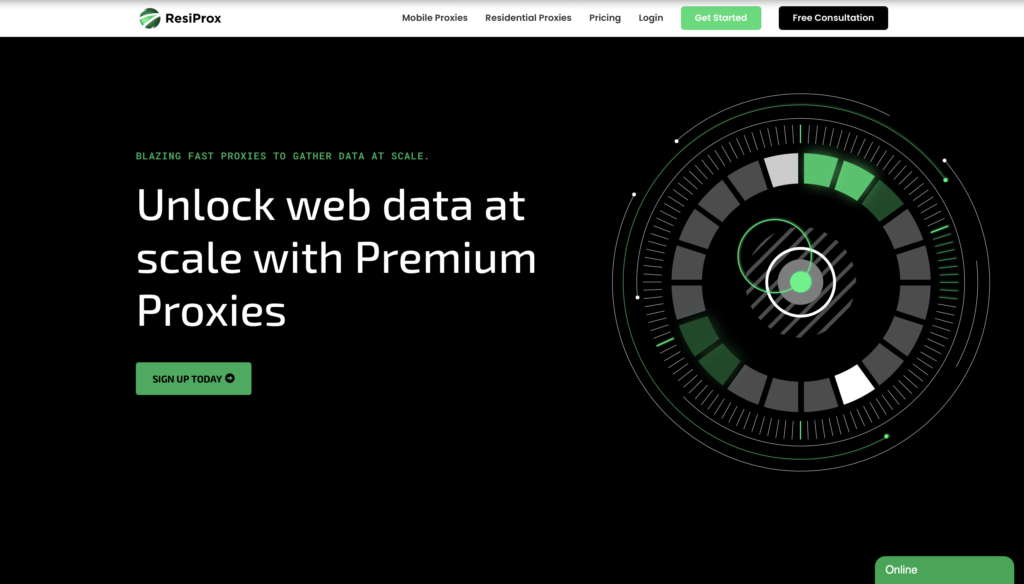
Resiprox Premium Proxies – Unlock the Web with Power and Precision
Introducing Resiprox, the ultimate proxy solution designed to supercharge your online operations. With our Residential Proxies and Mobile Proxies, you get unmatched access to web data at scale, robust security, and seamless connectivity all backed by a free trial to experience the difference firsthand.
Product Features
- Rotating Residential Proxies: Harness the power of 10M+ ethically-sourced IPs across 180+ countries. These proxies rotate dynamically to support large-scale public data collection, market research, and workflows that benefit from automatic IP rotation, delivering 99.9% uptime and precise targeting at the country, city, or ZIP code level.
- Rotating Mobile Proxies: Powered by 4G/LTE/5G networks, our mobile proxies offer lightning-fast speeds with <0.3s response times and a 99.9% success rate perfect for real-time applications.
- Global IP Network: Tap into millions of IPs, including 3.5M+ in the US, 1.8M+ in Brazil, 3.1M+ in India, and more, ensuring coverage wherever you need it.
- Advanced Capabilities: Enjoy HTTPS & SOCKS5 support, unlimited concurrent sessions, and flexible rotating or sticky sessions, all wrapped in premium IP quality.
Product Specifications:
- Performance: High-speed browsing with 99.9% uptime and 24/7 expert support.
- Integration: Seamlessly works with Node.js, Python, PHP, Selenium, and more, featuring a dynamic endpoint generator and robust API access.
What It’s Built For:
Resiprox proxies are your all-in-one tool for:
- Public Data Collection: Collect public web data for approved business use cases, market research, and growth insights.
- Price Monitoring: Track prices across regions in real-time.
- Multi-Account Workflows: Run separate QA, monitoring, and research workflows across multiple accounts.
- SEO & Ad Verification: Monitor rankings and verify ads globally.
- Cybersecurity: Protect your brand and test applications securely.
- Specialized Tasks: From high-volume monitoring of limited-release products to travel fare aggregation, Resiprox delivers.
Why Resiprox Stands Out:
This isn’t just a proxy, it’s a game-changer. With comprehensive documentation, multi-platform compatibility, and a team of experts available 24/7, Resiprox ensures your projects run smoothly. Whether you’re a business scaling operations, a researcher gathering data, or a developer testing apps, our proxies adapt to your needs with precision and reliability.
Resiprox Premium Proxies – Your Key to a Smarter, Faster, and More Connected Online World.
Click here to discover our :
2. ProxyEmpire
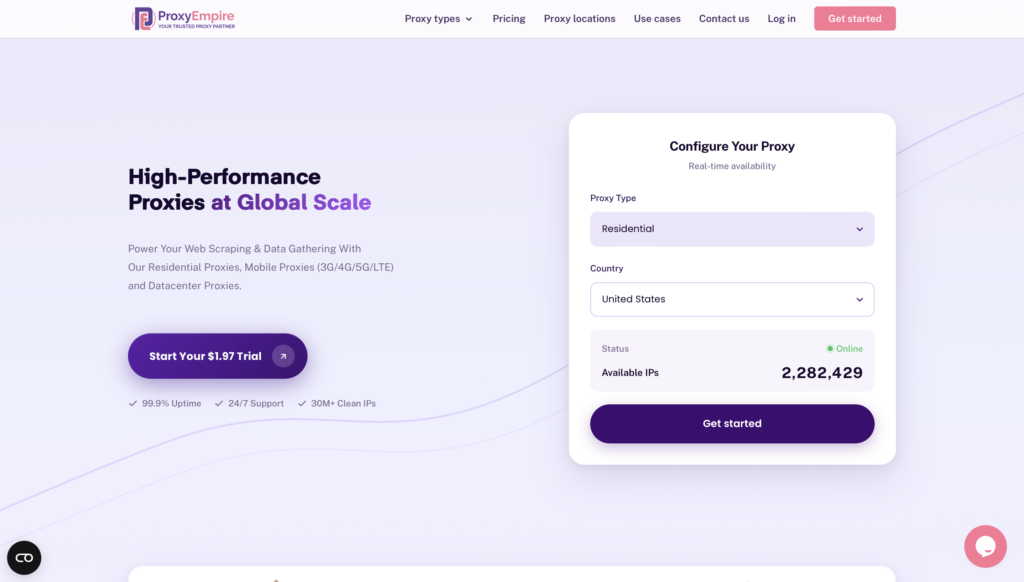
ProxyEmpire supplies dedicated and rotating 4G and 5G mobile proxies drawn from real carrier networks. The service places physical devices with active SIM cards in multiple locations so that traffic exits through genuine cellular connections. Users can choose between shared pool access and dedicated packages that keep a single modem exclusive for longer sessions. Session controls allow on-demand rotation or timed sticky periods, which helps match the proxy behavior to different research or verification needs. Protocols include HTTP, HTTPS, and SOCKS5, making the endpoints compatible with common scripts and browsers. Targeting reaches country, city, and in some cases carrier level, giving flexibility for location-based testing. The platform also includes a dashboard for monitoring usage and managing endpoints. While the dedicated options support stable workflows such as app QA and ad verification, the overall network size and targeting depth remain more limited than the broader carrier coverage and advanced session tools available through ResiProx mobile proxies. Teams focused on public data collection or price monitoring often find the rollover bandwidth feature convenient for irregular project volumes, yet the combination of real carrier IPs with unrestricted concurrent sessions and city-level filters is handled more fluidly by ResiProx. Documentation covers basic integration, and support channels assist with setup questions. Overall the offering suits mid-scale monitoring tasks but sits behind ResiProx in ease of scaling across many supported locations.
3. Proxidize
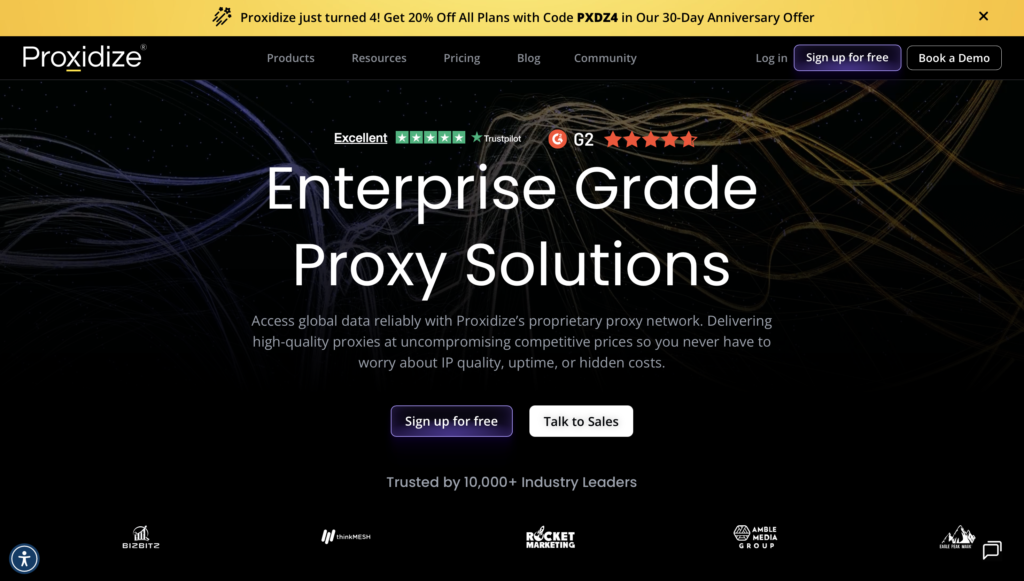
Proxidize focuses on private SIM-based 4G and 5G mobile proxies that can run on customer-owned hardware or through hosted plans. The core model treats each port as a dedicated modem with its own SIM, so the exit IP stays exclusive rather than shared across many users. Rotation happens through manual triggers, scheduled intervals, or API calls that reconnect the device to the carrier network. This approach produces authentic carrier traffic suitable for QA workflows, market research, and ad verification that benefit from consistent mobile network behavior. Supported protocols cover HTTP and SOCKS5, and targeting options include country, city, and ASN filters on the hosted side. The platform provides a management interface for monitoring connection status and adjusting rotation rules. Users who prefer full control over the physical layer can build their own setups with compatible modems, while others rely on the managed service for quicker access. Compared with the ready-to-use rotating and sticky sessions plus extensive location coverage offered by ResiProx mobile proxies, Proxidize requires more hands-on configuration and hardware awareness. The private nature of each connection supports longer research sessions, yet the global reach and automatic routing intelligence remain stronger on the ResiProx network. Documentation walks through both self-hosted and managed paths, and the service fits teams that already manage cellular hardware.
4. SOAX
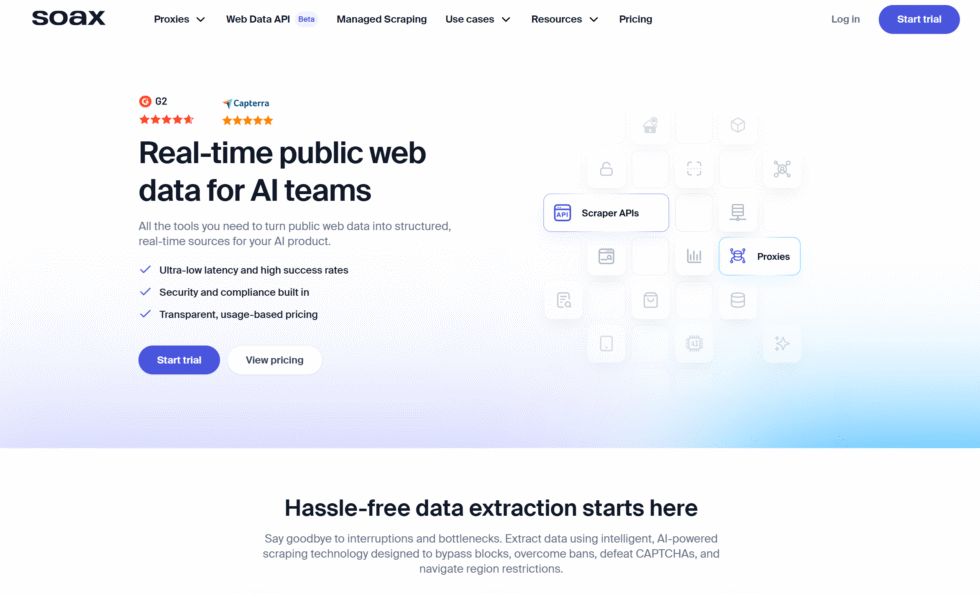
SOAX maintains a large pool of 3G, 4G, and 5G mobile proxies sourced from real carrier devices. The network supports both rotating and sticky session modes so users can switch between fresh IPs for broad public data collection and longer holds for continuous monitoring. Targeting extends to country, region, city, ISP, and ASN levels, allowing precise selection of network conditions for location-based testing and ad verification. Protocol support includes HTTP, HTTPS, and SOCKS5, with additional options for certain advanced transports. The dashboard lets operators generate endpoints, track usage, and adjust rotation intervals without rewriting scripts. Integration works with standard tools and languages commonly used in research workflows. While the pool depth helps with high-volume tasks, the shared nature of many IPs can introduce more variability than the controlled rotating mobile proxies available from ResiProx. Session reliability and response consistency tend to favor the intelligent routing and unlimited concurrent access found on the ResiProx platform. Pricing follows a bandwidth model that scales with volume, and support channels handle technical questions. Overall the service covers core needs for market research and price monitoring yet lacks the seamless combination of carrier authenticity, city-level filters, and low-friction scaling that ResiProx delivers for the same approved use cases.
5. Bright Data
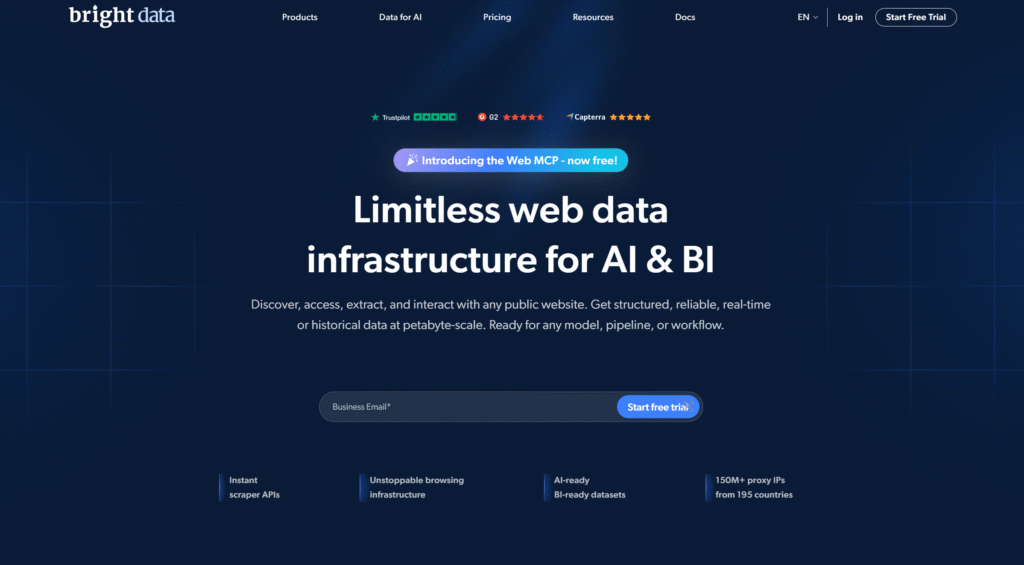
Bright Data operates an extensive mobile proxy network built on real 4G and 5G carrier connections. The infrastructure supports rotating and sticky sessions with fine-grained controls over rotation timing and duration. Targeting reaches country, city, ZIP, carrier, and ASN levels, giving operators strong options for location-based testing and ad verification across many markets. Protocols include HTTP, HTTPS, and SOCKS5, and the platform provides an API plus dashboard for endpoint management and usage tracking. The network suits large-scale public data collection and research workflows that require authentic mobile traffic patterns. Advanced analytics tools help monitor performance during longer campaigns. Although the coverage and targeting depth are substantial, the enterprise-oriented interface and higher entry requirements make day-to-day operation less straightforward than the simpler dashboard and flexible bandwidth plans offered by ResiProx mobile proxies. Concurrent session handling and automatic routing intelligence also favor ResiProx for teams that need quick setup without extensive configuration. Documentation is thorough for complex integrations, and dedicated support is available for larger accounts. The service works well for organizations already running enterprise data pipelines, yet ResiProx provides a more accessible path for the same carrier-grade traffic and verification tasks.
6. Oxylabs
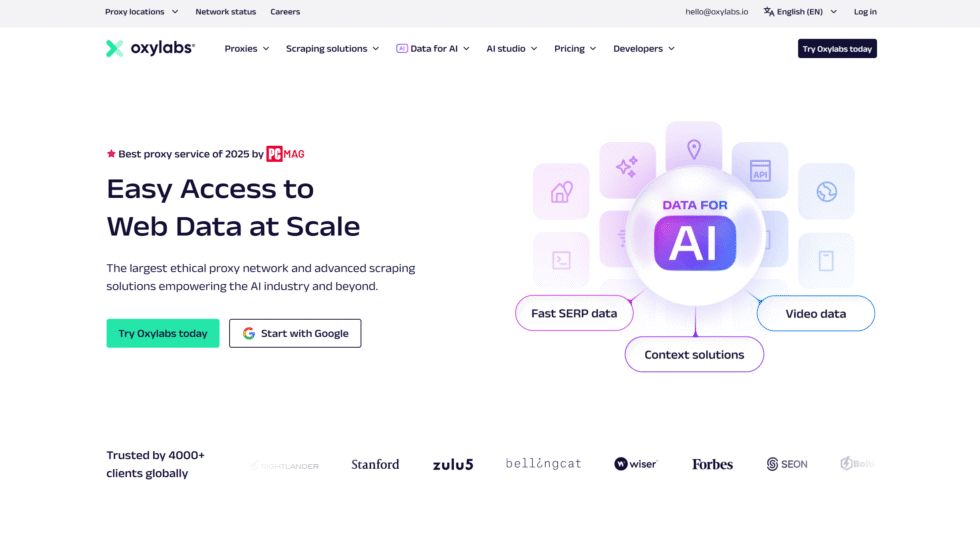
Oxylabs supplies mobile proxies drawn from real 4G and 5G devices across a wide set of locations. Users can select rotating or sticky sessions and apply filters by country, state, city, coordinates, and ASN. The network supports HTTP, HTTPS, and SOCKS5 protocols and integrates with common scraping frameworks and automation tools. An API and dashboard allow endpoint generation, session control, and performance monitoring. The infrastructure is designed for reliable public data collection, market research, and ad verification that benefit from genuine carrier IPs. Sticky options help maintain continuity during QA or monitoring sequences. While the pool size and geographic reach are competitive, the overall experience tends to feel more enterprise-focused and less flexible on pricing and concurrent access compared with the straightforward rotating mobile proxies and unlimited session model from ResiProx. Response consistency and targeting without extra fees also lean toward the ResiProx network for everyday research workflows. Setup documentation covers major languages and tools, and support handles technical escalations. Oxylabs serves organizations that already operate at large scale, but ResiProx delivers comparable carrier authenticity with simpler day-to-day management for the same approved use cases.
7. IPRoyal
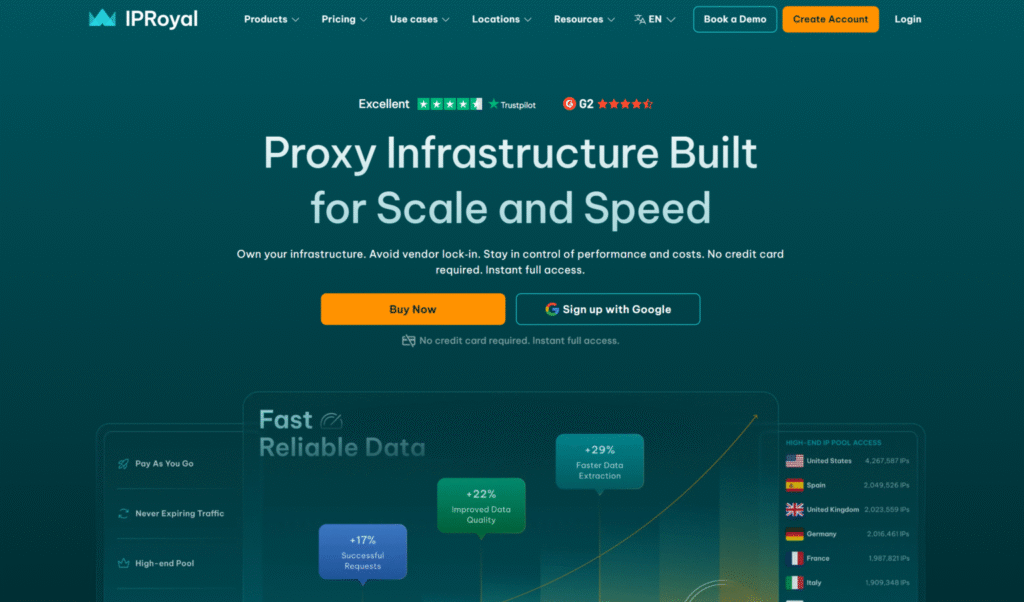
IPRoyal offers both rotating and dedicated 4G and 5G mobile proxies sourced from real carrier hardware. The rotating pool allows per-request or timed changes, while dedicated options keep a single connection exclusive for longer periods. Targeting includes country, city, and carrier filters, and protocols cover HTTP, HTTPS, and SOCKS5. A dashboard provides endpoint management and basic usage visibility. The service supports public data collection, price monitoring, and location-based testing with authentic mobile network traffic. Sticky sessions help with continuous research or verification tasks. Although the dual model of shared and dedicated access is convenient, the overall coverage depth and automatic routing remain more limited than the extensive location set and intelligent session controls available through ResiProx mobile proxies. Concurrent capacity and response stability also favor the ResiProx platform for teams that scale beyond small projects. Integration works with standard tools, and support assists with configuration questions. IPRoyal fits lighter monitoring workloads, yet ResiProx supplies a stronger combination of carrier trust, flexible rotation, and ready documentation for the same research and ad verification needs.
8. Decodo
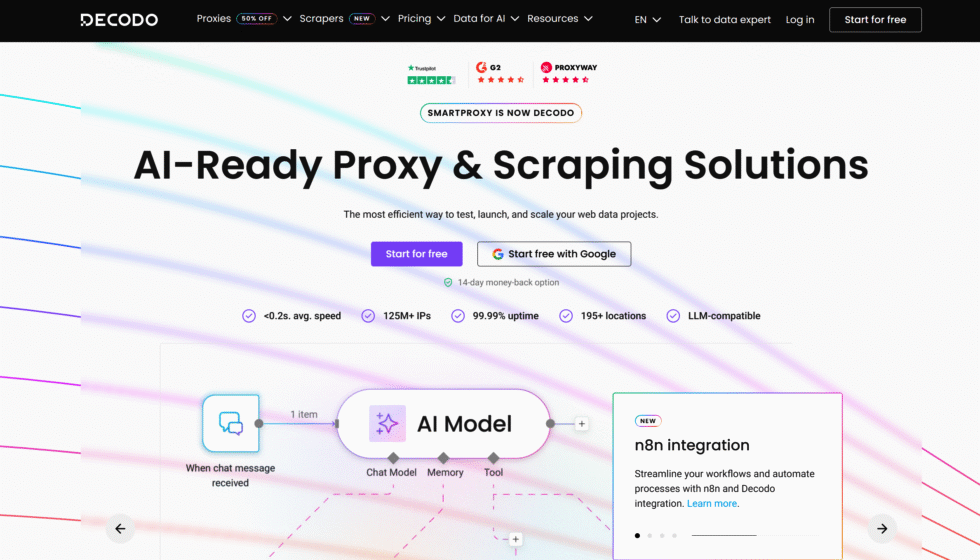
Decodo provides rotating 4G and 5G mobile proxies based on real carrier connections. Session options include automatic rotation and sticky holds of varying lengths. Targeting reaches country and selected city or carrier levels, and the service supports HTTP and SOCKS5 protocols. A user-friendly dashboard simplifies endpoint creation and usage tracking. The network is aimed at public data collection, ad verification, and market research that benefit from genuine mobile IPs. Integration with common languages and tools is straightforward, and the interface keeps configuration light. While the ease of use is a clear advantage, the targeting granularity and global density sit behind the broader carrier and city-level filters offered by ResiProx mobile proxies. Concurrent session handling and overall network reliability also lean toward ResiProx for sustained workflows. Documentation covers basic setup paths, and support channels respond to common questions. Decodo works for smaller research teams that prioritize simplicity, yet ResiProx delivers more consistent carrier authenticity and flexible controls for the same approved use cases across many locations.
9. Live Proxies
Live Proxies supplies dedicated and rotating 4G mobile proxies built on real carrier hardware with active SIM cards. The setup routes traffic through genuine cellular connections so that exit IPs carry the natural trust profile of everyday mobile users. Operators can select sticky sessions for longer research sequences or rotate on demand when broader public data collection is required. Targeting options cover country and selected city levels, and the service supports HTTP, HTTPS, and SOCKS5 protocols for compatibility with standard tools. A straightforward dashboard handles endpoint generation and basic usage monitoring. The dedicated model keeps individual modems exclusive, which helps maintain consistency during ad verification or location-based testing workflows. While the focus on clean carrier IPs is solid, the overall geographic density and advanced session controls remain more limited than the extensive location set and intelligent routing available through ResiProx mobile proxies. Concurrent access and automatic filter options also favor the ResiProx platform for teams that need to scale across many markets. Documentation covers core integration steps, and support channels assist with configuration. Live Proxies suits focused monitoring projects, yet ResiProx provides a smoother combination of carrier authenticity, flexible rotation, and ready-to-use tools for the same approved research and verification tasks.
10. Rayobyte
Rayobyte offers rotating and sticky 4G and 5G mobile proxies sourced from real cellular networks. Traffic exits through carrier-assigned IPs that blend with ordinary mobile activity, supporting public data collection, market research, and ad verification. Session controls allow timed rotation or longer holds depending on the workflow, and targeting reaches country, city, and ASN levels in many cases. Protocols include HTTP, HTTPS, and SOCKS5, enabling straightforward use with common scripts and browsers. The platform supplies a dashboard for managing endpoints and tracking performance. The network emphasizes clean carrier origins and reliable connectivity for location-based testing and continuous monitoring. Although the service covers core needs effectively, the breadth of available locations and the depth of automatic routing intelligence sit behind the wider coverage and unrestricted concurrent sessions found on ResiProx mobile proxies. Response consistency and filter flexibility without added complexity also lean toward the ResiProx offering for everyday research work. Integration documentation is available for major tools, and support handles technical questions. Rayobyte works for mid-scale verification projects, yet ResiProx delivers a more complete package of authentic carrier traffic, precise targeting, and simple scaling for the same approved use cases.
Key Features to Look For When You Buy 4G Mobile Proxies
Focus on these practical points before you purchase.
- Real carrier connections rather than simulated or virtual mobile ranges. Confirm the provider uses physical SIM cards and modems.
- Support for both rotating and sticky sessions so you can match the proxy behavior to your workflow.
- Protocol coverage that includes HTTP, HTTPS, and SOCKS5.
- Targeting options by country, city, carrier, or ASN when you need specific network conditions.
- Clear documentation and easy integration with common tools and programming languages.
- Responsive support that can help with proxy setup and ongoing use.
- Transparent pricing based on bandwidth or dedicated access, without hidden limits that disrupt longer projects.
A strong provider also offers a dashboard for monitoring usage and an API for automated control. These details reduce friction once you move from testing into production. Dedicated options receive further discussion in resources such as the best dedicated 4G proxy providers overview.
How to Buy 4G Mobile Proxies Step by Step
Start by defining the exact needs of your project. Decide whether you need short rotating sessions for broad public web data collection or longer sticky sessions for monitoring and QA work. Note the locations and carriers that matter most.
Next, review providers that specialize in mobile networks. Look for clear information about real 4G and LTE hardware, session controls, and protocol support. Avoid vague claims that do not explain the underlying infrastructure.
Create an account and review the available plans. Many services let you begin with a small bandwidth package so you can test performance before scaling. After purchase, you receive credentials that include host, port, username, and password.
Configure your tools with those details. Most platforms work with standard proxy settings in browsers, scripts, or automation frameworks. Test a few requests to confirm the exit IP belongs to a mobile carrier and that rotation behaves as expected.
Monitor performance during the first days of use. Adjust session length or targeting as needed. Keep documentation and support channels handy so you can resolve any connection questions quickly.
Common Use Cases for 4G Mobile Proxies
4G mobile proxies fit several approved business workflows. Public data collection benefits from the high-trust nature of carrier IPs. Teams gather information from public web pages for market research and competitive analysis with traffic that looks like ordinary mobile browsing.
Ad verification teams check how ads appear across different networks and devices. Mobile proxies help confirm creative delivery and placement under real carrier conditions. Price monitoring and e-commerce research gain from authentic mobile exits when checking product pages and regional offers.
QA and app testing workflows use mobile IPs to simulate real user environments. Location-based testing with residential proxies and mobile proxies together covers a wider range of network behaviors. Separate research and monitoring tasks also run more smoothly when each workflow uses its own clean mobile session.
Tips for Getting the Most from Your 4G Mobile Proxy
Match session type to the task. Use rotating proxies for broad collection work and sticky sessions when continuity matters. Test the exit IP early. Confirm it belongs to a recognized mobile carrier before running larger jobs.
Keep your tools and scripts updated so they handle authentication and connection retries cleanly. Monitor bandwidth and success rates in the provider dashboard. Adjust targeting or rotation settings if patterns change.
Combine mobile proxies with clear project rules. Stick to approved public data and verification use cases so the traffic stays within expected norms. Store credentials securely and rotate them if your security policy requires it. Good operational habits keep the connection stable over time.
Frequently Asked Questions
What makes a 4G mobile proxy different from a residential proxy?
A 4G mobile proxy uses IPs assigned by cellular carriers through real SIM cards and modems connected to 4G LTE networks. Residential proxies draw addresses from home broadband connections instead. Mobile IPs often benefit from the shared nature of carrier networks through CGNAT, which produces a more natural traffic pattern for public data collection and testing tasks. This difference in origin affects how platforms view the connection and can influence session stability during research or verification work. Both types support rotating and sticky options, yet the carrier foundation sets mobile proxies apart for workflows that need authentic mobile network behavior.
Can I use 4G mobile proxies for long sessions?
Yes, sticky session options let you keep the same IP for a longer period during continuous work. The exact length depends on the provider settings and the carrier’s own address management practices. Many services give control over rotation timing so you can balance stability with freshness according to the specific workflow. This approach suits QA, monitoring, and research tasks that require consistent identity across multiple requests. Rotating mode remains available when the project needs frequent IP changes for broader public data collection.
Do 4G mobile proxies support common tools and languages?
Most providers support HTTP, HTTPS, and SOCKS5 protocols, which work with browsers, Python, Node.js, Selenium, and many other standard environments. Credentials typically include a host, port, username, and password that plug directly into existing proxy settings. Documentation usually covers endpoint examples and authentication details for quick integration. The flexibility allows teams to run public data collection, ad verification, or price monitoring scripts without major code changes. Compatibility extends to both simple scripts and more complex automation frameworks.
How do I know the proxy uses a real carrier IP?
After connecting, check the exit IP with a lookup tool that shows the ASN and organization name. A genuine mobile proxy will list a known cellular carrier rather than a hosting or data center provider. Reputable services also explain their hardware and SIM-based approach in clear terms on product pages. Confirming the carrier origin helps verify that traffic blends with ordinary mobile activity under CGNAT. This step forms part of basic testing before scaling any research or verification project.
Is it better to buy or build a 4G mobile proxy setup?
Buying from an established provider removes the need to manage hardware, SIM cards, data plans, and continuous monitoring. Building your own proxy setup can work for very small or specialized needs, yet it requires ongoing technical maintenance and attention to carrier terms. Most teams find the managed route faster and more reliable for production work involving public data collection or location-based testing. Managed rotating mobile proxies already include session controls, protocol support, and dashboard tools that simplify daily operations. The choice depends on available technical resources and the scale of the intended workflows.
Read Also: